With infrared lamps heat transfer is easy. It requires no contact with the material and no intermediate such as air or water. High power can be transmitted; foils, plates and other material are heated in seconds.
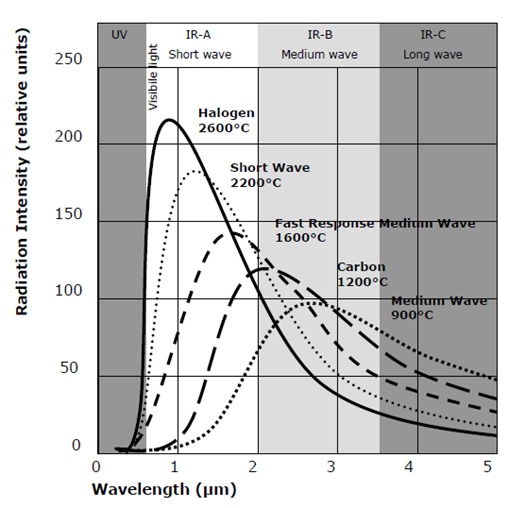
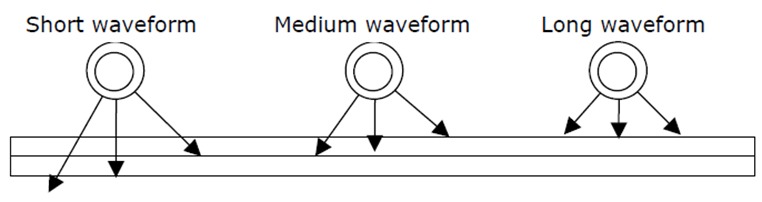
There are a number of infrared types, the most common being short, medium & long waveform. Medium and long wave infrared lamp applications can be treated as a standard resistive load with no additional considerations.
Short-wave infrared lamps provide fast, high-intensity radiant heating for industrial processes.
They typically use a tungsten filament inside a quartz tube and reach operating temperature almost instantly. Because the filament has a much lower resistance when cold, the lamp can draw a high inrush current at start-up. The thyristor controller must therefore manage both the cold-start current and the rapid response of the lamp.
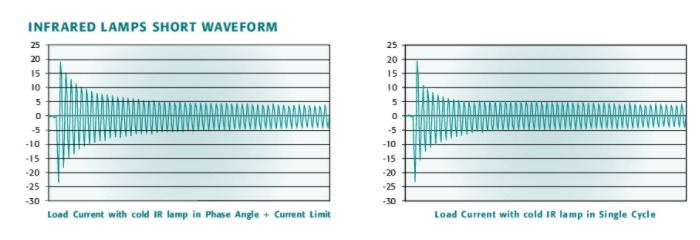
The graph above demonstrates how the inrush current remains high for a longer period if we use Phase Angle plus current limit, than with say Single Cycle.
Single Cycle technique is the most used to drive infrared short waveform. During the OFF time the SWIR elements become cold (due to their low inertia) with a resulting current peak when switched ON again. This current peak is a function of the number of Burst Firing cycles, for this reason the OFF time must be as short as possible to reduce this current peak. Phase Angle firing is not used because the supply voltage is normally less than nominal and therefore the elements never reach the working temperature.
So to summarise:
Care must also be taken with short-wave lamps that require very low voltages. This is a typical requirement in the motor industry and with the paint spraying/curing process.
Special thyristor sizing considerations must be made as the voltage supply can be lower than nominal values causing a lower peak but a very long overcurrent that can stress the thyristor semiconductors. Contact your nearest CD Automation outlet with your SWIR lamp specifications for help in sizing the correct thyristor power controller.
Typical infrared applications include the forming and processing of:
Product Suggestion:
For single phase loads we suggest REVEX 1PH for currents up to 210A, or REVO-C 1PH.
For 3 phase loads we recommend REVO-C 3PH.
CD Automation can help you size the controller, manage lamp inrush current and select the correct firing mode, soft start and diagnostic functions.
Speak to a Power Control Specialist
Send us your lamp data, electrical supply and heating-zone details.
Call 01323 811 100 or submit your application details today.

