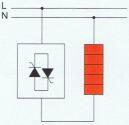
A Thyristor is a semiconductor device which acts as a switch. However, when switched on it can only pass current in one direction. It is in fact a switchable diode sometimes known as a silicon controlled rectifier (SCR).
To switch alternating current (AC), two devices are connected in inverse parallel. Each device is turned on at the appropriate time by a trigger pulse applied to the gate and the device will remain on until the instantaneous load current through it drops to zero. The trigger pulses are generated by a driver, which times the pulse to ensure the thyristor unit output is a function of the input demand signal firing mode.
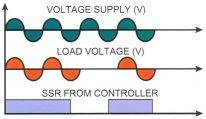
The ZC firing mode is used with the logic output from a temperature controller, for example, and the thyristor operates like a contactor. The cycle time is determined by the temperature controller. ZC minimises interference due to the fact that the thyristor unit switches ON and OFF at zero volts.
Burst Firing (BF)
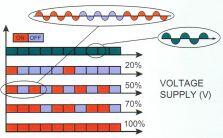
This firing is performed digitally within the thyristor unit at zero volts, producing no EMC interference. Analogue input is necessary for BF and the number of complete cycles must be specified for 50% power demand. This value can be between 1 and 255 complete cycles, determining the speed of firing. When 1 is specified, the firing mode becomes Single Cycle (SC).
Single Cycle (SC)
SC is the fastest zero crossing switching method. At 50% input signal, one cycle is ON and one cycle is OFF. At 75%, 3 cycles are ON and one cycle is OFF. If power demand is 76%, the unit performs the same as for 75% but every time the unit switches ON the microprocessor divides 76/75 and memorises the ratio. When the sum is one, the unit delivers one cycle more to the load.
With this firing it is necessary to have an analogue input. SC is ideal for simple resistance loads and where thermal mass of the load is small or as a low noise alternative to PA firing with some applications.
Phase Angle (PA)
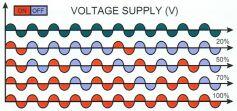
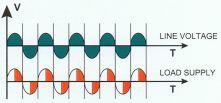
PA controls the power to the load by allowing the thyristor to conduct for part of the AC supply cycle only. The more power required, the more the conduction angle is advanced until virtually the whole cycle is conducting for 100% power. The load power can be adjusted from 0 to 100% as a function of the analogue input signal, normally determined by a temperature controller or potentiometer.
PA is normally used with inductive loads. Filters may need to be used to remove any resulting interference generated.
Visit our Thyristor range to find the right thyristor for your application.
Our Address
Unit 9 Harvington Business Park, Brampton Rd, Eastbourne, BN22 9BN, UK
Inside, you’ll discover the 5 common mistakes that can affect machine performance and how to avoid them to save time, reduce downtime, and improve product quality.
🎉 Thank you! Your download is ready.
You can access your PDF now by clicking the link below:
This paper explores how integrated thyristor power and temperature control improves heating consistency, energy efficiency, and reliability, helping UK manufacturers reduce downtime, extend equipment lifespan, and shift from reactive to predictive maintenance.