Lead Forensics
Home » Industry & Applications » Silicon Carbide (SiC) Heating Element

Silicon Carbide (SiC) Heating Element

Silicon carbide heating elements are designed for demanding, high-temperature industrial processes.

Unlike normal-resistance heaters, their electrical resistance changes significantly during operation and gradually increases as the element ages. This makes accurate power regulation and sufficient voltage reserve essential.

Where Are SiC Elements Used?

Silicon carbide elements are commonly used in:

  • High-temperature kilns
  • Industrial furnaces
  • Ceramic firing
  • Glass processing
  • Metal heat treatment
  • Laboratory furnaces
  • Semiconductor processing
  • High-temperature test equipment

They are selected where conventional metallic elements may not provide the required operating temperature, durability or performance.

Why Use Silicon Carbide?

SiC elements offer several advantages for high-temperature heating:

  • High operating temperatures
  • Rapid heat-up capability
  • Good thermal-shock resistance
  • Strong radiant heat output
  • Straightforward installation and replacement
  • Operation in a range of furnace atmospheres

Their robust construction makes them particularly suitable for furnaces, kilns and other intensive thermal processes.
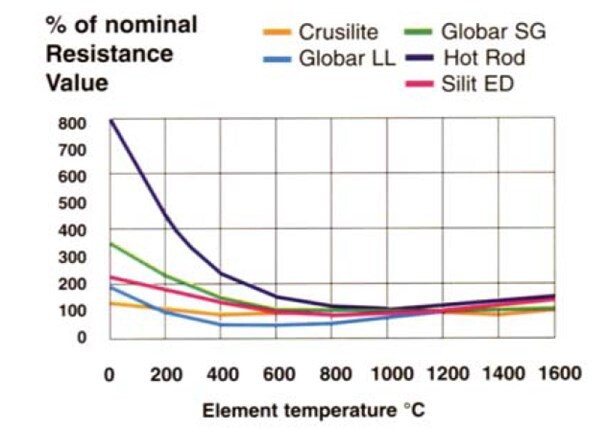
Silicon carbide heating curve

Why Are SiC Elements More Difficult to Control?

The resistance of a silicon carbide element does not remain constant throughout its working life.

As the element ages, its resistance increases. The power-control system must therefore progressively apply more voltage to maintain the required heat output.

A correctly designed system should provide:

  • Controlled start-up
  • Accurate power regulation
  • Voltage reserve for element ageing
  • Current or voltage limiting
  • Stable heat output
  • Load monitoring and diagnostics

Without sufficient voltage reserve, an ageing element may eventually be unable to reach the required process temperature.

What Is the Best Control Method?

Phase-angle firing with true power feedback is often the preferred method for SiC heating elements.

Phase-angle control varies the RMS voltage applied during each mains cycle, providing smooth and responsive power adjustment.

True power regulation compensates for changes in supply voltage and element resistance, helping maintain consistent heat delivery throughout the element’s operating life.

Key benefits include:

  • Smooth power delivery
  • Controlled element start-up
  • Stable process temperature
  • Compensation for resistance changes
  • Current and voltage limiting
  • Improved use of the element’s working life

The controller and transformer arrangement must be sized with enough voltage headroom to compensate for future element ageing.

Recommended CD Automation Controller

REVO C

REVO C provides the advanced firing, regulation and diagnostic functions required for silicon carbide heating applications.

Depending on the system configuration, it can provide:

  • Phase-angle firing
  • True power regulation
  • Current and voltage feedback
  • Current limiting
  • Voltage limiting
  • Soft start
  • Heater-break detection
  • Load monitoring
  • Analogue control
  • PLC and fieldbus communications

REVO C can be used with directly connected elements or transformer-fed heating systems, subject to the electrical design and required operating voltage.

Correct Sizing Is Essential

A silicon carbide controller cannot be selected from heater kW alone.

We will need to review:

  • Supply voltage and phases
  • Element voltage
  • Element current and power
  • Number of elements
  • Series or parallel arrangement
  • New and aged resistance values
  • Transformer details
  • Required operating temperature
  • Control signal
  • Monitoring and communication requirements

Need Help Controlling SiC Elements?

CD Automation can help you assess the element characteristics, calculate the required voltage reserve and select the correct REVO controller, firing mode and transformer arrangement.

Speak to a Power Control Specialist

Send us your element data, electrical supply and furnace requirements.

Call 01323 811 100 or submit your application details today.

 

SiC Heating Element
Our Address
Unit 9 Harvington Business Park, Brampton Rd, Eastbourne, BN22 9BN, UK
Need Help?
We aim to reply to email enquiries within 20 minutes (during normal working hours).
CD Automation UK Limited © Copyright 2026. All Rights Reserved.

Please send me this document

🎉 Thank you! Your download is ready.

You can access your PDF now by clicking the link below:
Inside, you’ll discover the 5 common mistakes that can affect machine performance and how to avoid them to save time, reduce downtime, and improve product quality.

🎉 Thank you! Your download is ready.

You can access your PDF now by clicking the link below:
This paper explores how integrated thyristor power and temperature
control improves heating consistency, energy efficiency, and reliability,
helping UK manufacturers reduce downtime, extend equipment lifespan,
and shift from reactive to predictive maintenance.