A thyristor is a semiconductor device used to switch and control electrical power. In simple terms, it acts as an electronic switch, but unlike a mechanical contactor it contains no moving parts.
When switched on, a thyristor allows current to pass in one direction only. For this reason, a thyristor is sometimes described as a switchable diode and is also commonly known as a Silicon Controlled Rectifier (SCR).
Thyristors are widely used in industrial applications where accurate and reliable control of electrical heating loads is required. When incorporated into a thyristor power controller, they can provide precise control of the power delivered to resistive, infrared, transformer and inductive loads.
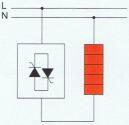
To control alternating current (AC), two thyristor devices are connected in inverse parallel, allowing each half of the AC waveform to be controlled.
Each thyristor is switched on at the appropriate point in the AC cycle by a trigger pulse applied to its gate. Once conducting, the device remains switched on until the instantaneous load current flowing through it falls to zero.
The trigger pulses are generated by the thyristor controller's firing circuit or driver. The timing of these pulses determines how much power is supplied to the load and depends upon the selected thyristor firing mode and the input demand signal.
Different firing modes allow the power controller to be optimised for the electrical load and process requirements.
View our Thyristor range to explore our thyristor power controllers and switching solutions.
How Does a Thyristor Control Power?
Rather than simply switching a heater permanently ON or OFF, a thyristor power controller can regulate the amount of electrical energy delivered to the load.
The method used to control this power is known as the firing mode.
Selecting the correct firing mode is important because it can affect:
Temperature control accuracy
Electrical efficiency
EMC and electrical interference
Heater life
Transformer performance
Current demand and peak loading
Process stability
The most commonly used thyristor firing modes are Zero Crossing (ZC), Burst Firing (BF), Single Cycle (SC) and Phase Angle (PA).
Basic Thyristor Firing Modes
Zero Crossing (ZC)
Zero Crossing (ZC) firing is one of the simplest methods of controlling a thyristor.
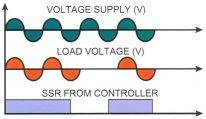
It is commonly used with the logic output from a temperature controller, with the thyristor power controller operating in a similar way to a solid state contactor.
The temperature controller determines the cycle time and instructs the thyristor unit when to switch ON and OFF.
Importantly, switching takes place as the AC voltage passes through zero volts. Switching at the zero crossing point helps minimise electrical interference and makes ZC particularly suitable for straightforward resistive heating applications.
Typical advantages of Zero Crossing firing include:
Simple and reliable power switching
Low electrical noise
Reduced EMC interference
No mechanical contact wear
Suitable for resistive heating loads
Burst Firing (BF)
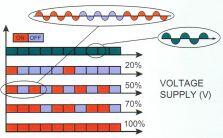
Burst Firing (BF) controls power by supplying groups, or bursts, of complete AC cycles to the load.
The switching is performed digitally within the thyristor unit and takes place at zero volts. Because complete AC cycles are switched at the zero crossing point, Burst Firing produces very low EMC interference compared with Phase Angle control.
An analogue input signal is normally used to determine the required power output.
The number of complete cycles used at 50% power demand can typically be configured between 1 and 255 cycles. This setting determines how quickly the controller switches batches of complete cycles ON and OFF.
For example, a longer burst period may be appropriate for loads with a high thermal mass, while a shorter burst period provides a faster response for applications requiring tighter power control.
When the setting is reduced to one complete cycle, the firing method becomes Single Cycle (SC).
Burst Firing is widely used for resistive heating applications because it combines accurate power control with low electrical interference.
Single Cycle (SC)
Single Cycle (SC) is the fastest form of zero crossing switching.
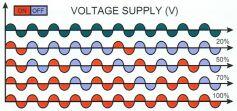
Instead of switching groups of many complete AC cycles, Single Cycle firing distributes individual complete cycles according to the power demand.
For example:
At 50% power demand, one complete cycle is ON followed by one complete cycle OFF.
At 75% power demand, three cycles are ON followed by one cycle OFF.
For demand values between these exact ratios, the thyristor controller's microprocessor calculates the required additional cycles and distributes them over time to achieve the requested average power.
For example, at 76% power demand the unit initially operates using the 75% firing pattern. The microprocessor then calculates and stores the difference between the requested and delivered power. When the accumulated difference reaches the equivalent of one complete cycle, an additional cycle is supplied to the load.
An analogue input is required when using Single Cycle firing.
SC is particularly suitable for simple resistance loads, applications where the thermal mass of the load is small, and situations where a fast-response, low-noise alternative to Phase Angle firing is required.
Because switching still takes place at the zero crossing point, Single Cycle firing provides rapid power modulation while maintaining very low electrical interference.
Phase Angle (PA)
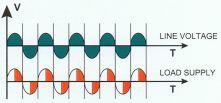
Phase Angle (PA) firing provides extremely precise control by controlling how much of each AC half cycle is supplied to the load.
Instead of waiting for a complete cycle to switch ON or OFF, the thyristor is triggered at a controlled point within each AC half-cycle.
When only a small amount of power is required, the thyristor conducts for a relatively short part of the waveform. As the power demand increases, the firing point is progressively advanced so that the thyristor conducts for a greater proportion of each half cycle.
At close to 100% power demand, virtually the complete AC waveform is supplied to the load.
This allows the load power to be smoothly adjusted from 0 to 100% as a function of the analogue input signal, typically supplied by a temperature controller, PLC, process controller or potentiometer.
Phase Angle control is commonly used with:
Inductive loads
Transformer-coupled loads
Loads requiring controlled voltage
Applications requiring very fast power adjustment
Some infrared heating systems
Because the AC waveform is being switched part way through each cycle, Phase Angle firing can generate greater electrical and EMC interference than zero crossing firing methods. Filters or other EMC measures may therefore be required depending on the installation.
Which Thyristor Firing Mode Should I Use?
The correct firing mode depends on the electrical characteristics of the load and the response required from the heating process.
As a general guide:
Firing Mode
Typical Application
Key Benefit
Zero Crossing (ZC)
Resistive heaters controlled from a logic output
Simple switching with very low interference
Burst Firing (BF)
Industrial resistance heating
Accurate proportional control with low EMC emissions
Single Cycle (SC)
Low thermal mass resistance loads
Very fast zero crossing power control
Phase Angle (PA)
Inductive, transformer or specialised loads
Smooth and highly responsive power regulation
Choosing the right firing mode can improve temperature stability, heater life, energy control and overall process performance.
Thyristor Power Controllers for Industrial Heating
CD Automation has extensive experience in the design and manufacture of thyristor power controllers for industrial electrical heating applications.
Our power controllers can be used across a wide range of applications, including resistance heaters, infrared heaters, transformer loads and other demanding industrial processes.
Modern thyristor controllers can also provide functionality beyond basic power switching, including power measurement, current and voltage monitoring, load diagnostics and communication with PLC and automation systems.
The ideal thyristor power controller depends on factors such as your supply voltage, load current or kW rating, number of phases, heater or load type, control signal and required firing mode.
If you're unsure whether your application requires Zero Crossing, Burst Firing, Single Cycle or Phase Angle control, contact CD Automation and our team can help you select the most appropriate solution.
Our Address
Unit 9 Harvington Business Park, Brampton Rd, Eastbourne, BN22 9BN, UK
Inside, you’ll discover the 5 common mistakes that can affect machine performance and how to avoid them to save time, reduce downtime, and improve product quality.
🎉 Thank you! Your download is ready.
You can access your PDF now by clicking the link below:
This paper explores how integrated thyristor power and temperature control improves heating consistency, energy efficiency, and reliability, helping UK manufacturers reduce downtime, extend equipment lifespan, and shift from reactive to predictive maintenance.