A failed heating zone rarely stops at one cold element. It can trigger rejected batches, unstable temperatures, breaker trips and a production plan that no longer holds. Knowing how to reduce heating system downtime therefore means treating electrical heating as production critical infrastructure, not a panel component to inspect only after a fault.
For industrial manufacturers, the most reliable route is a combination of correct power control specification, condition led maintenance and fast, disciplined fault finding. Each measure reduces a different source of lost time. Together, they protect process repeatability, energy control and OEE.
Heating failures are often blamed on the heater, yet the underlying problem may sit in the control circuit, supply network, panel cooling or process design. A controller can fail prematurely because it was selected for the nominal load current but not the true inrush current. Equally, an element may burn out because of poor temperature sensing or rapid switching that does not suit the application.

Most recurring events fall into four connected areas:
However, the pattern matters more than the individual alarm. A controller that repeatedly trips on overcurrent needs a load and supply investigation. Simply resetting it restores production briefly, but it leaves the underlying risk in place.
The first reliability decision is made before equipment is commissioned. Power controllers must be matched to the load type, phase arrangement, operating voltage and required control method. Those details determine electrical stress, process performance and the available protection functions.
Resistive loads are not all electrically identical. A low temperature alloy element may have modest cold resistance variation, while silicon carbide and molybdenum disilicide heaters can draw substantial inrush current or change resistance as they age. Infrared lamps, transformers and some induction related loads create different switching demands again.
Therefore, nominal current alone is not a safe selection basis. Engineers should establish cold current, maximum operating current, duty cycle, ambient temperature, supply tolerance and expected element ageing. This information allows the controller, semiconductor fuse, contactor and cable arrangement to be sized as a system.
Phase configuration also deserves close attention. A three phase load may be star or delta connected, balanced or unbalanced, and controlled in two or three legs. Consequently, the wrong arrangement can create uneven heating, nuisance protection trips or a difficult-to-diagnose loss of one phase.
Phase angle control provides close power regulation and can be valuable where the thermal response is fast. Yet it can introduce harmonics and electromagnetic interference if the wider installation is not considered. Burst firing, by comparison, is often well suited to resistive heating loads with sufficient thermal inertia and can reduce electrical disturbance.
Likewise, soft start functions can limit cold inrush and extend heater life. Fast cycling applications may need a different strategy from a slow moving furnace zone. The right answer depends on the load and process, not on a default controller setting.
A load specific specification review at this stage is cheaper than repeated unplanned stoppages later. CD Automation UK works with OEMs, system integrators and end users to select suitable thyristor power controllers based on load characteristics, electrical configuration, firing modes and integration requirements. This application led approach helps ensure the controller is correctly specified from the outset, reducing the risk of avoidable failures and production interruptions.
CD Automation's thyristor controllers offer a range of firing strategies, allowing engineers to select the most appropriate control method for the heater characteristics and process requirements. Correct firing mode selection can improve temperature stability, manage electrical demand and reduce unnecessary stress on heating elements.
A dependable controller cannot compensate for a poorly managed panel environment. Heat is the common enemy of semiconductor devices, terminals and insulation. Inadequate ventilation, blocked filters and undersized enclosures steadily shorten component life, even when the process appears to run normally.
Firstly, allow adequate clearance around heatsinks and follow the power controller's mounting orientation requirements. Secondly, confirm that enclosure cooling remains effective at the highest expected ambient temperature. Finally, inspect for dust, fibre, oil mist and other contamination that can restrict airflow or create tracking paths.
Electrical protection must also be coordinated. Semiconductor fuses protect thyristors far faster than standard branch protection in many fault conditions. However, the fuse rating and I²t characteristics must suit the power controller and load. An oversized device may leave expensive power electronics exposed, while an undersized device creates avoidable production interruptions.
EMI power line filters, correctly terminated earth connections and sensible separation between power and signal wiring further improve stability. As a result, temperature control signals are less likely to be disturbed by switching noise. This is particularly relevant where multiple high power zones operate in the same cabinet.
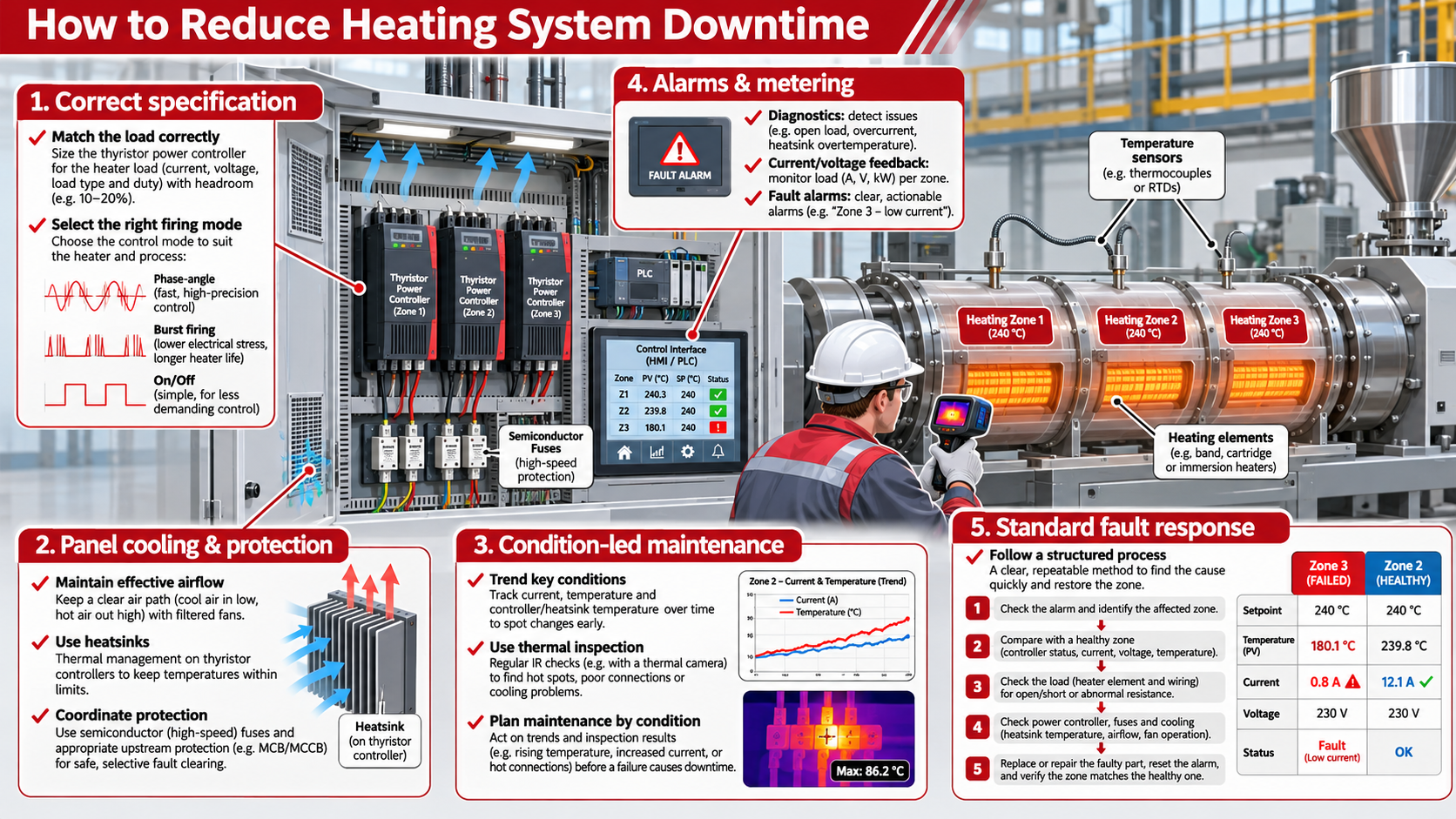
Fixed maintenance intervals have value, but they can waste labour on stable zones and miss rapidly deteriorating ones. Condition led maintenance uses operating data to focus attention where failure risk is rising.
At a practical level, trend the current drawn by each heating zone against its control demand and product temperature. A gradual change in load current, when compared against the same power demand and supply conditions, can indicate heater deterioration, changing element resistance or a developing electrical fault. Similarly, a zone that takes longer to reach setpoint may reveal reduced heater output before it causes a shutdown.
During planned shutdowns, torque check terminals to the manufacturer’s requirements and look for discolouration around lugs, fuses and contactors. Thermal imaging is especially useful when the equipment is energised safely. It can reveal high resistance joints before they become a burnt termination or a phase loss event.
Heatsinks should be kept clean, while cooling fans need checking for noise, reduced airflow and bearing wear. Thermocouples and RTDs also require attention because a drifting sensor can drive a healthy heater incorrectly. In addition, inspect element supports, ceramic insulation and mechanical alignment where vibration or thermal expansion is present.
Record each finding by zone, asset and date. That history turns isolated repair notes into evidence. Over time, maintenance teams can identify which heater banks, control cabinets or operating conditions account for the most lost hours.
Downtime is not only the time taken to repair a failure. It also includes the period spent proving what has failed. Clear diagnostics shorten that second phase substantially.
Power network meters can show voltage imbalance, excessive demand, missing phases and abnormal current. Temperature controllers can identify sensor break, high deviation and failure to reach setpoint. Meanwhile, advanced thyristor controllers may provide load fault, overtemperature or fuse failure indications, depending on the configuration.
The useful question is not simply whether an alarm exists. It is whether the alarm points an engineer to the right physical check.
Modern thyristor power controllers, such as CD Automation's REVO range, can provide valuable diagnostic information, including load monitoring, heater break detection, current and voltage feedback, and fault alarms, depending on the model and configuration. Integrating this information into a PLC or plant monitoring system can help maintenance teams identify developing problems before they result in unplanned downtime.
For example, a temperature that continues to rise despite a low or zero power demand may indicate a sensor issue, an external heat source or a fault within the power switching circuit. Conversely, low temperature despite a high power demand may indicate insufficient heater output, element failure or loss of supply.
Set alarm limits with the process team, rather than relying only on generic defaults. Tight limits can expose quality risks early, but excessively sensitive limits may create nuisance call outs. The right threshold reflects product tolerance, thermal mass and the time available to intervene.
Where supported, industrial communications such as Modbus, PROFINET or EtherCAT can also make controller status and diagnostic data available to the wider automation system, helping engineers investigate faults without relying solely on local panel indicators.
Even well designed systems will eventually need repair. The objective is to contain the event, restore safe operation and prevent recurrence. A short fault response standard reduces variation between shifts and stops hurried changes from creating a second problem.
A practical sequence is to make the equipment safe, capture the controller and process alarms, check supply and protection status, then test the heater circuit and sensor loop. After that, compare the affected zone with a healthy equivalent zone. This approach is usually faster than changing the controller first.
Critical spares should reflect actual failure exposure. A site with many identical controllers may justify holding a configured spare, suitable fuses, fans, sensors and approved connection hardware. Conversely, expensive low risk parts may be better supported through a rapid supplier route. Stocking decisions should be based on lead time, consequence of failure and the likelihood of use.
Documentation is equally valuable. Keep current panel drawings, controller parameters, fuse specifications and heater circuit test values available at the point of maintenance. When a night shift fault occurs, accurate information can save hours.
Reliable industrial heating depends on correct power controller specification, effective diagnostics and proactive maintenance. By combining suitable thyristor control technology with application engineering expertise, manufacturers can improve heating reliability, minimise unplanned downtime and maintain consistent process performance.
CD Automation UK supports manufacturers with thyristor power control solutions designed around their electrical heating applications, helping improve system reliability and long term operational performance.
Reducing heating system downtime starts with understanding how the electrical heating system operates as a whole. The thyristor power controller is one part of that system, working alongside the heating elements, temperature controls, electrical protection and wider automation equipment.
At CD Automation, we help customers assess their heating applications and identify suitable power control solutions. That means looking beyond the controller's current rating to consider load characteristics, firing modes, operating conditions and the monitoring capabilities that can help identify potential problems before they lead to production stoppages.
For a new installation, addressing these considerations during the design stage can help prevent reliability issues later. For an existing system, reviewing fault histories, load measurements and controller settings can help identify recurring problems and opportunities to improve performance.
Experiencing recurring heating faults, unexplained controller trips or avoidable production downtime?
Speak to CD Automation about your application. Our UK engineering team can help review your existing power control arrangement, assess the heating load and identify practical opportunities to improve reliability. Whether you're specifying a new installation or troubleshooting an existing system, we'll help you find the right approach for the application, not simply a replacement controller.
Power control reliability depends on the complete electrical path. A correctly rated controller can still fail prematurely if it sits in a hot enclosure with restricted airflow or is fed through undersized terminals.
Review the following items as part of the heater load calculation:
Moreover, consider diversity only when it is real and controlled. Several heating zones may not all run at full output during steady production, but they often do during heat up. Designing the incoming supply around an assumed diversity factor can create nuisance trips precisely when the machine needs maximum power.

What happens next?
This isn't an automated product-selection tool.
One of our team will look at the information you've provided and review the application from an engineering point of view.
We may come back with a few questions, but we'll normally be looking at things such as:
No lengthy specification needed.
Just give us enough information to get the conversation started.
Prefer to talk?
Call us on 01323 811100
CD Automation UK
Industrial power control. Backed by people who understand the application.
