
Pharmaceutical and biotech equipment must deliver more than performance, it must deliver proof of performance.
Every thermal process, whether used for drying, sterilisation or reaction control, operates within a validated framework. Equipment must demonstrate that it can achieve and maintain defined conditions consistently, across every cycle and over time.
For OEMs, this changes the role of the heating system. It is no longer just a means of delivering energy, but a critical part of ensuring process repeatability, documentation and regulatory compliance.
Achieving this requires precise control over how heat is applied, monitored and integrated into the wider system.

Validated processes depend on repeatability.
Equipment must operate within defined limits, with minimal variation between cycles. Any deviation must be understood, recorded and, where necessary, investigated.
Drying systems, such as tray dryers and fluid bed dryers, rely on stable temperature conditions to achieve consistent moisture removal.
Variations in heat input can affect drying rate and final moisture content, which directly impacts product stability and shelf life.
Sterilisation processes require precise temperature and time control to ensure effectiveness.
If temperature deviates from the required profile, the process may not achieve the intended result. Overheating can also damage sensitive materials.
Maintaining stable and traceable thermal conditions is essential to ensuring both efficacy and compliance.
In biotech and pharmaceutical reactors, temperature influences reaction behaviour, yield and product quality.
Consistent heat delivery ensures that reactions proceed under controlled conditions, supporting repeatable outcomes.
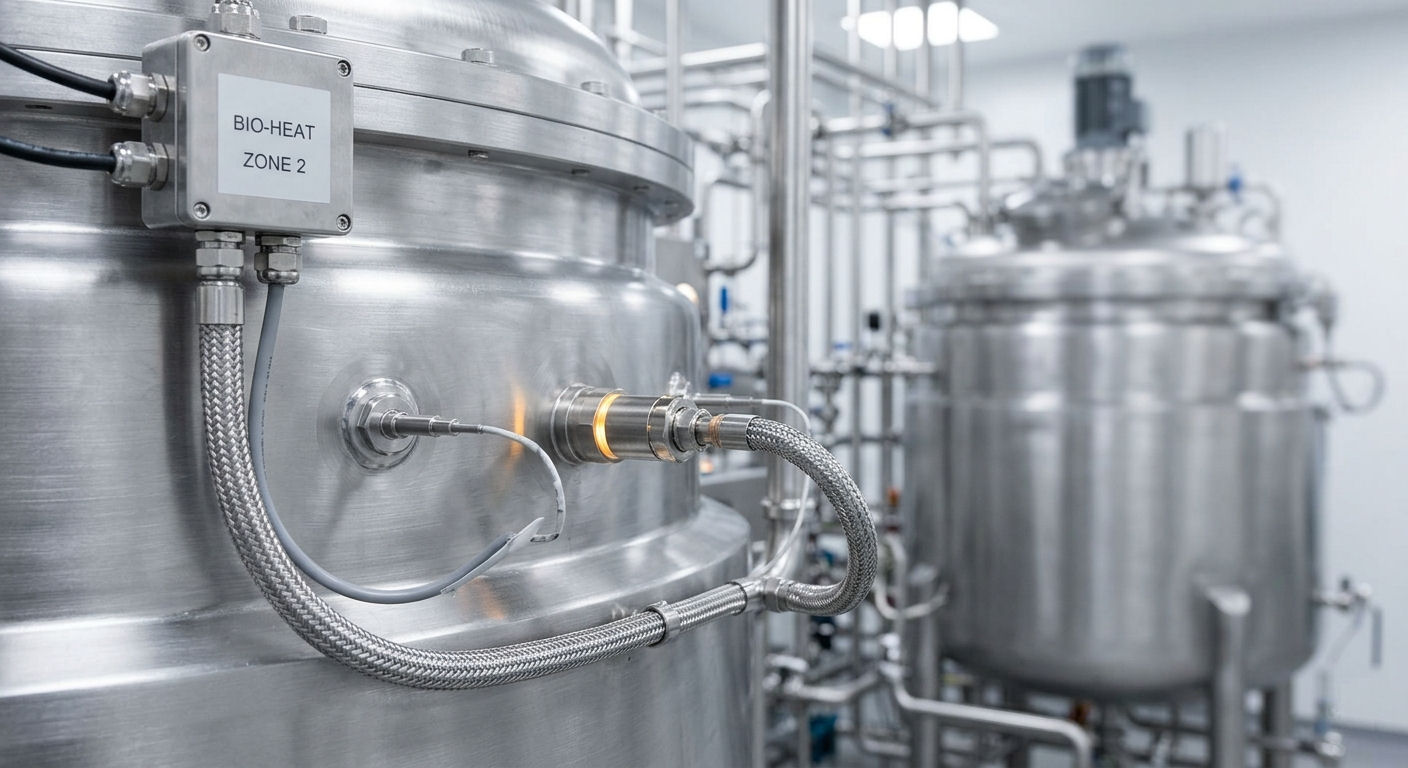
Traditional control approaches focus on maintaining a setpoint. In pharmaceutical systems, the requirement goes further.
Equipment must demonstrate that it can:
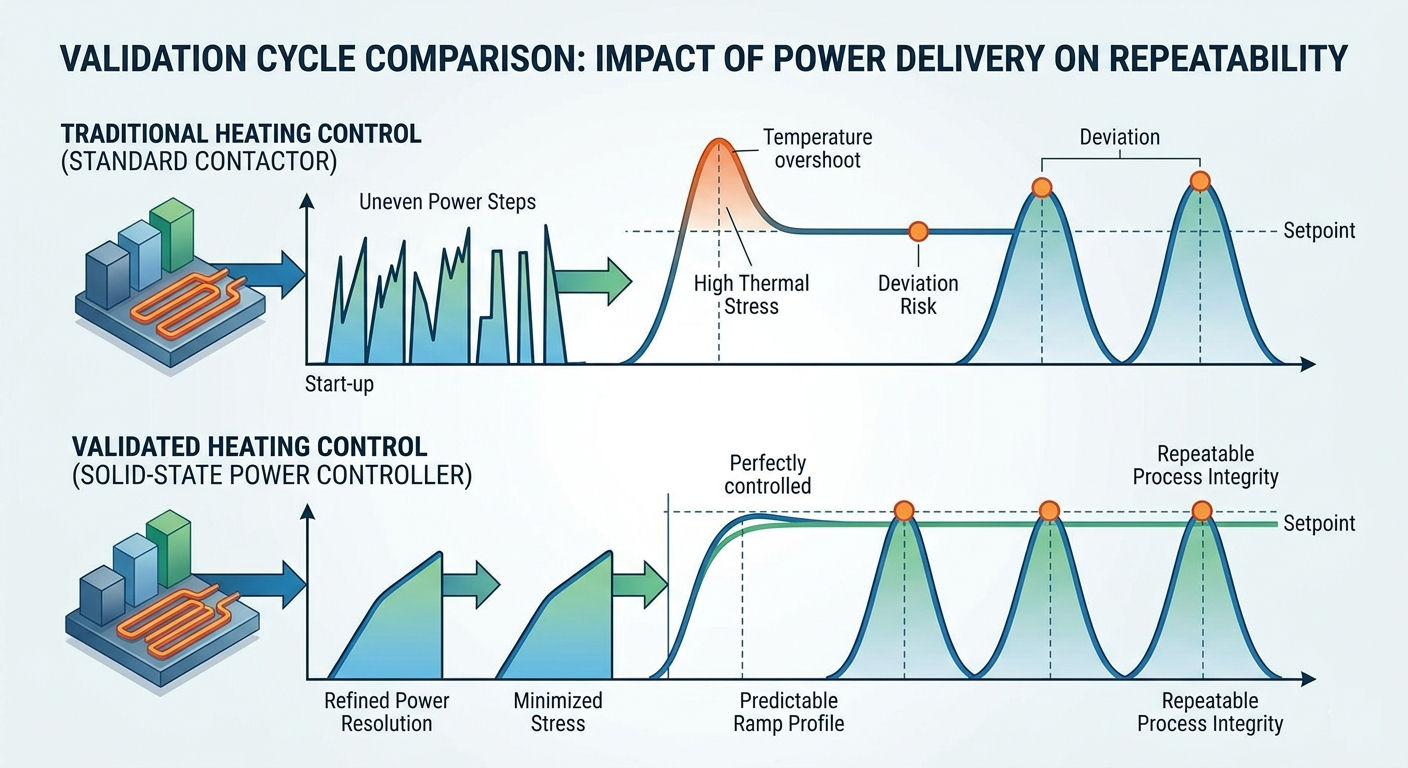
This places greater importance on how power is delivered to the heating system.
If power is applied unevenly or in large steps, it can introduce variation in heat input. While this may not always be visible at the temperature level, it can affect process repeatability over time.
More refined power control supports smoother heat delivery, reducing variation and improving consistency between cycles.
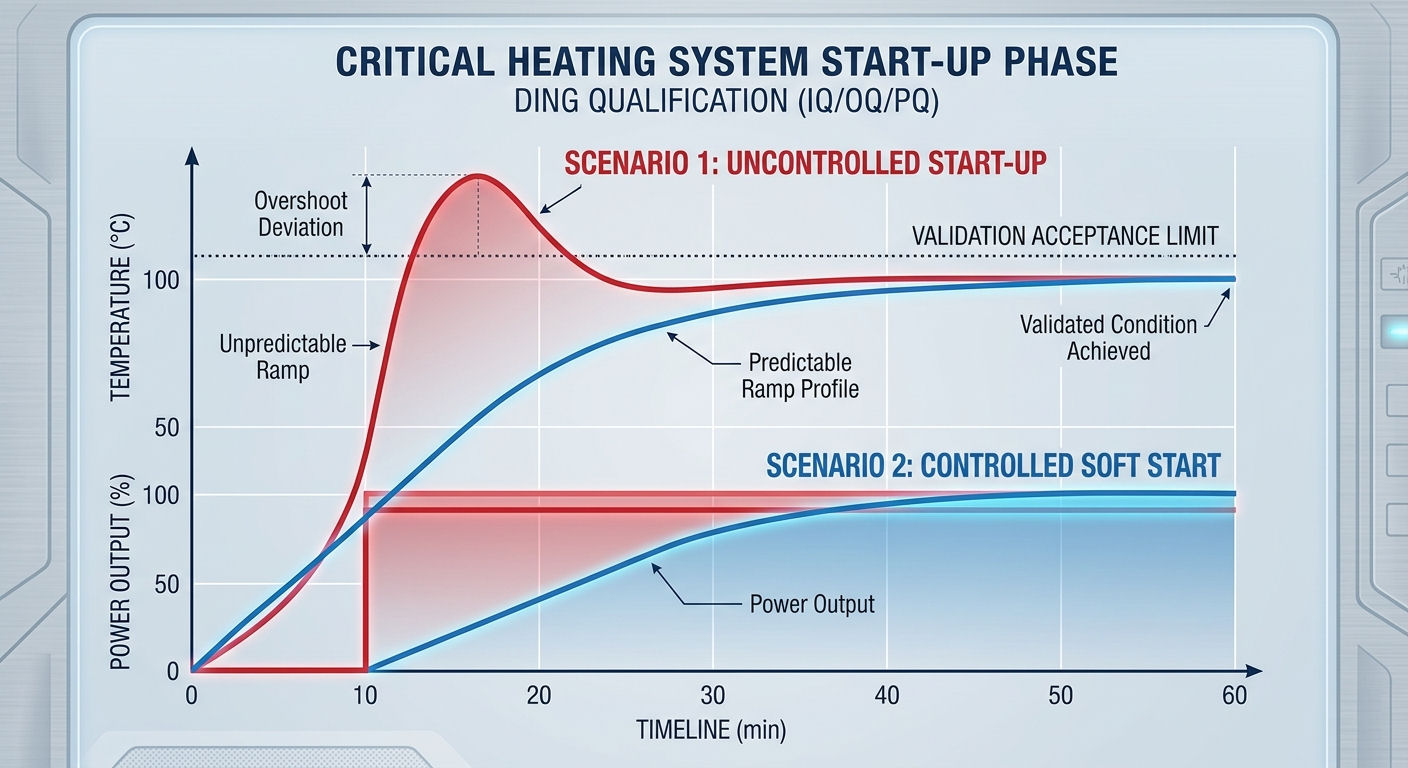
Start-up behaviour forms part of system validation.
Equipment must demonstrate consistent ramp-up characteristics, particularly during qualification phases such as IQ/OQ/PQ.
Applying full power at start-up can create overshoot or uncontrolled heating, making it difficult to achieve repeatable ramp profiles.
Power controllers that support soft start and current limiting allow controlled energisation of heating systems. This helps achieve consistent and predictable start-up behaviour, which is critical for validation.
The illustration to the right shows a typical Start-up Behavior Graph (Uncontrolled Start-up vs. Validated Ramp).
Pharmaceutical production often involves batch processes where interruption can result in product loss and compliance issues.
Heating system failures can lead to:
Mechanical contactors used for switching heaters introduce a potential point of failure due to wear over time.
Replacing these with solid-state power control improves reliability and reduces the risk of unexpected interruption.
Modern systems provide early fault detection, allowing heater issues or abnormal conditions to be identified before they affect the process.
This supports proactive maintenance and helps maintain validated operation.
Traceability forms a core requirement in pharmaceutical and biotech environments.
Operators must be able to demonstrate that process conditions were maintained throughout each cycle.
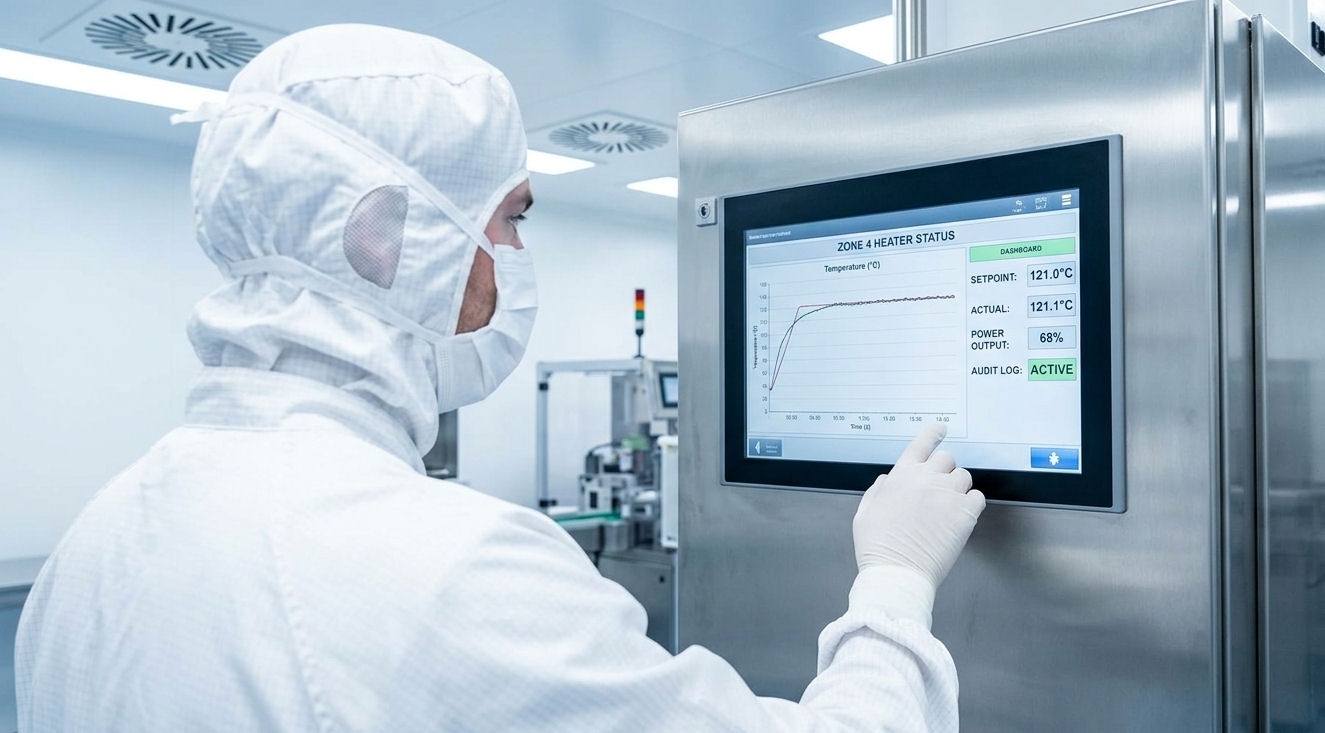
Modern power controllers provide real-time data and historical logging, allowing heating performance to be recorded alongside process parameters.
This data supports:
Having access to detailed heating data simplifies investigation and strengthens confidence in system performance.
Pharmaceutical equipment operates within tightly controlled automation environments.
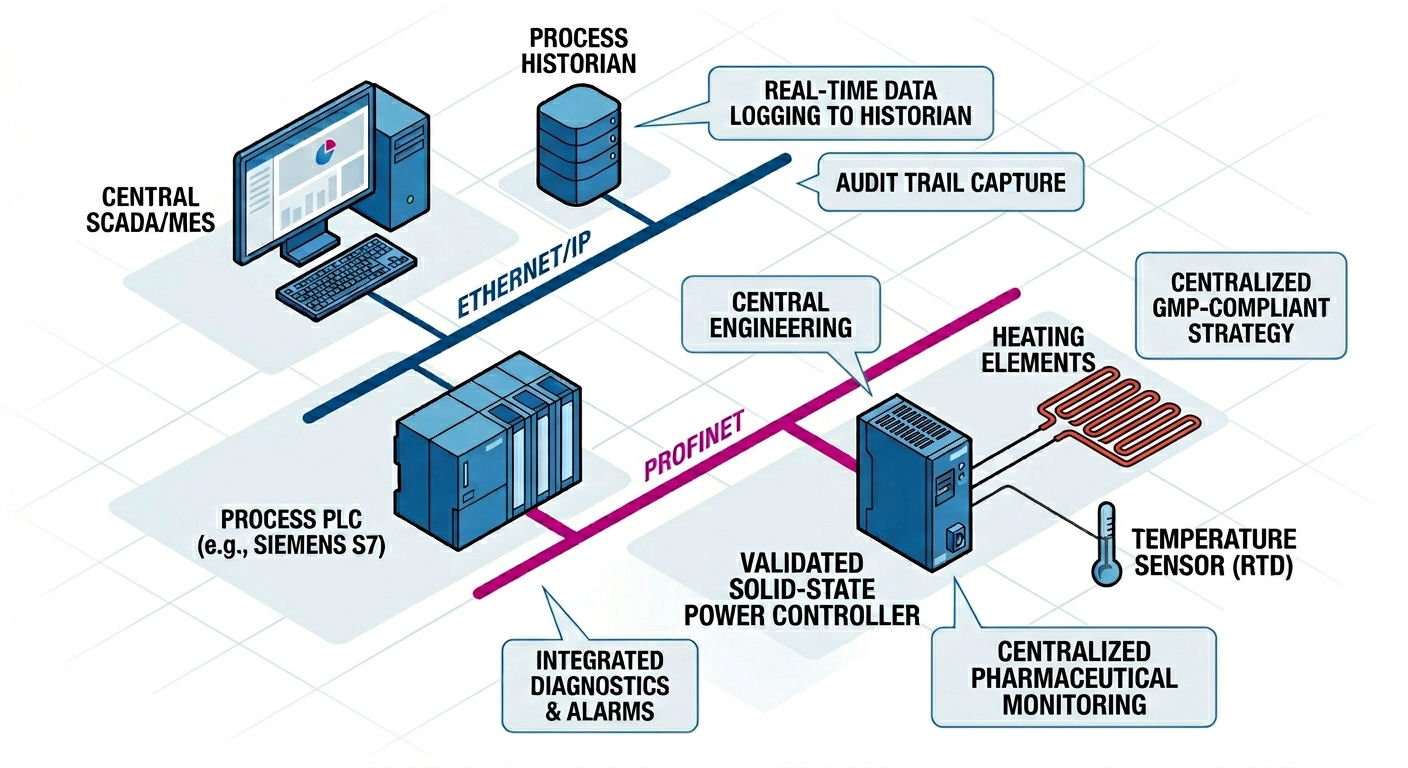
Power controllers that support Profinet and Profibus integrate directly with PLC and SCADA systems, allowing heating performance, alarms and diagnostics to be monitored centrally.
A typical system is shown in the illustration.
This ensures that heating systems operate in alignment with the overall control strategy and supports coordinated process control.
Integration also simplifies system validation by ensuring that all relevant data is available within the central control platform.
Consistent heating performance underpins product quality, compliance and operational efficiency.
By improving how power is delivered and monitored, OEMs can design equipment that delivers:
In regulated environments, this level of control provides both technical and operational assurance.
Selecting a power control solution in pharmaceutical and biotech applications requires consideration of both technical performance and compliance needs.
The system must support stable operation, provide clear diagnostic information and integrate seamlessly with validated control architectures.
CD Automation’s thyristor power controllers, including REVO S and REVO C, provide advanced firing modes, current limiting and diagnostic capability.
These systems deliver stable power control, early fault detection, data logging, real-time visibility and seamless integration with industrial control systems.
This enables OEMs to design equipment that meets both performance and validation requirements.

If you are designing pharmaceutical or biotech equipment and need to improve repeatability, support validation or enhance system reliability, CD Automation can support you in selecting the most appropriate power control solution.
Contact CD Automation to discuss your heating application or arrange a technical review of your system.
Further application information can be found on our Pharmaceutical, Biotech & Fine Chemical Production page.
Or contact our engineering team to assess your current heating control strategy.
Click the link in the page footer below to ‘Book a telephone callback’, or click the ‘Contact Us' button to request a no-obligation quotation, or simply ask a question. We're here to help.
