For any electrically heated process, controlling temperature is only part of the story. The method used to switch and regulate power has a direct effect on heater life, process stability, electrical noise, transformer behaviour, energy demand, and long-term reliability.
This is where thyristor power control becomes so important.
A thyristor controller does much more than simply turn a heater on and off. When correctly selected and configured, it controls how power is applied to the load. This is known as the firing mode, and choosing the right firing mode can make a significant difference to the performance of the heating process.
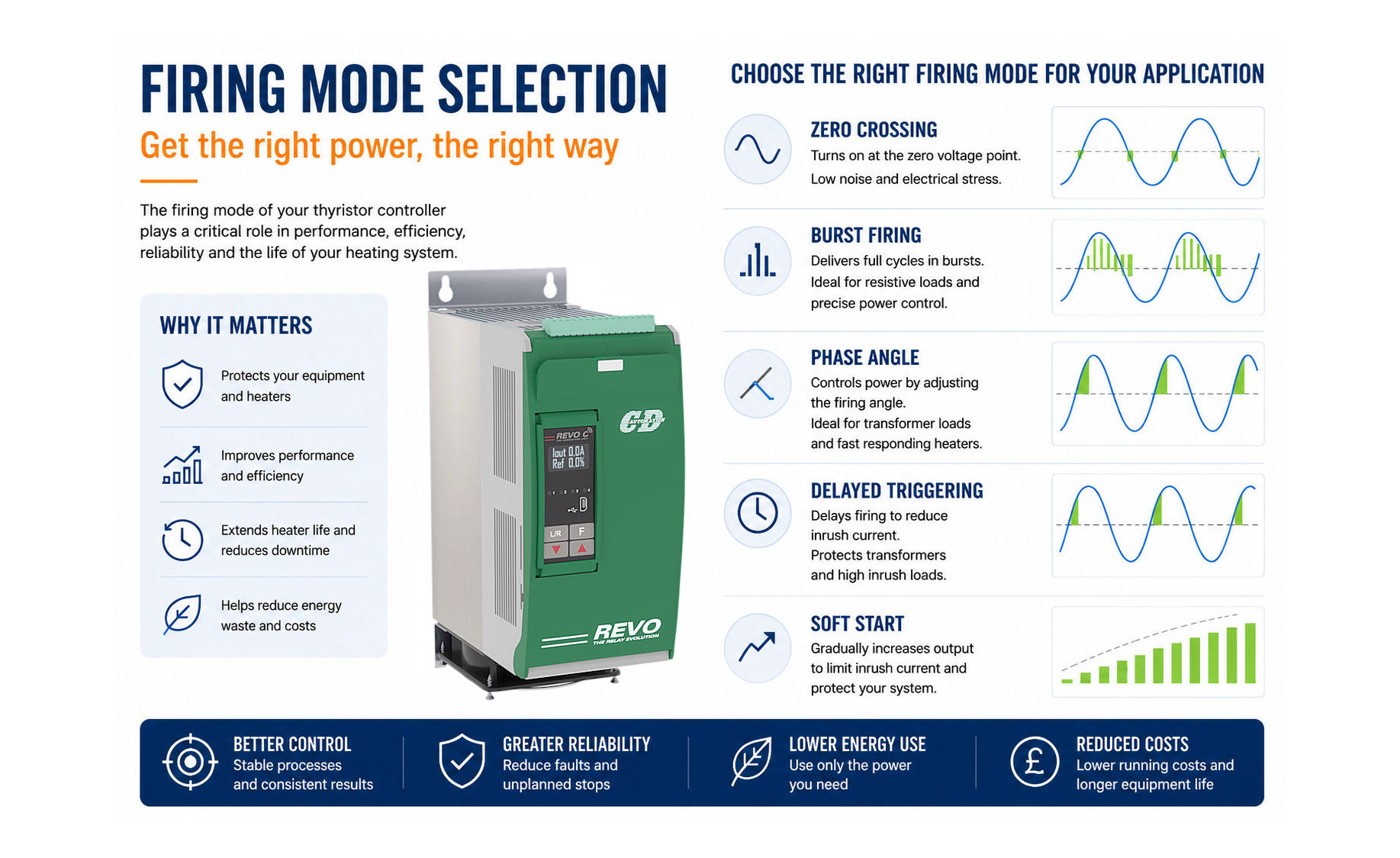
A firing mode is the method a thyristor power controller uses to apply electrical power to the heater.
In simple terms, it determines when the thyristors switch on during the AC waveform, how long they remain on, and how power is proportioned to the load.
Different heating applications behave in different ways. A standard resistive heater, a short-wave infrared lamp, a transformer primary, a silicon carbide element, and a multi-zone oven all place different demands on the power controller. Using the wrong firing mode may still produce heat, but it can also create instability, nuisance trips, excessive electrical noise, poor power factor, premature heater failure, or unnecessary stress on upstream electrical equipment.
The right firing mode helps the heating system work with the process, not against it.
The table below gives a simple overview of the main firing modes used in industrial heating applications. It should be used as a practical guide, as the final selection depends on the heater type, supply arrangement, load behaviour and process requirements.
|
Firing mode |
|
Zero crossing |
|
Burst firing |
|
Single cycle / half cycle |
|
Phase angle |
|
Delayed triggering |
|
Soft start / current limit |
|
Best suited to |
|
Simple, stable resistive loads |
|
Resistive heaters and medium or long-wave infrared heaters |
|
Fast-response heaters and processes |
|
Transformer primaries, short-wave infrared and complex loads |
|
Transformer-coupled loads |
|
High-inrush or variable-resistance loads |
|
Main customer benefit |
|
Clean, reliable switching with reduced electrical disturbance |
|
Smooth power control with low electrical noise |
|
Faster correction and improved temperature uniformity |
|
Precise control, smoother start-up and better current management |
|
Reduced inrush current and improved start-up reliability |
|
Protects heaters, fuses, transformers and upstream equipment |
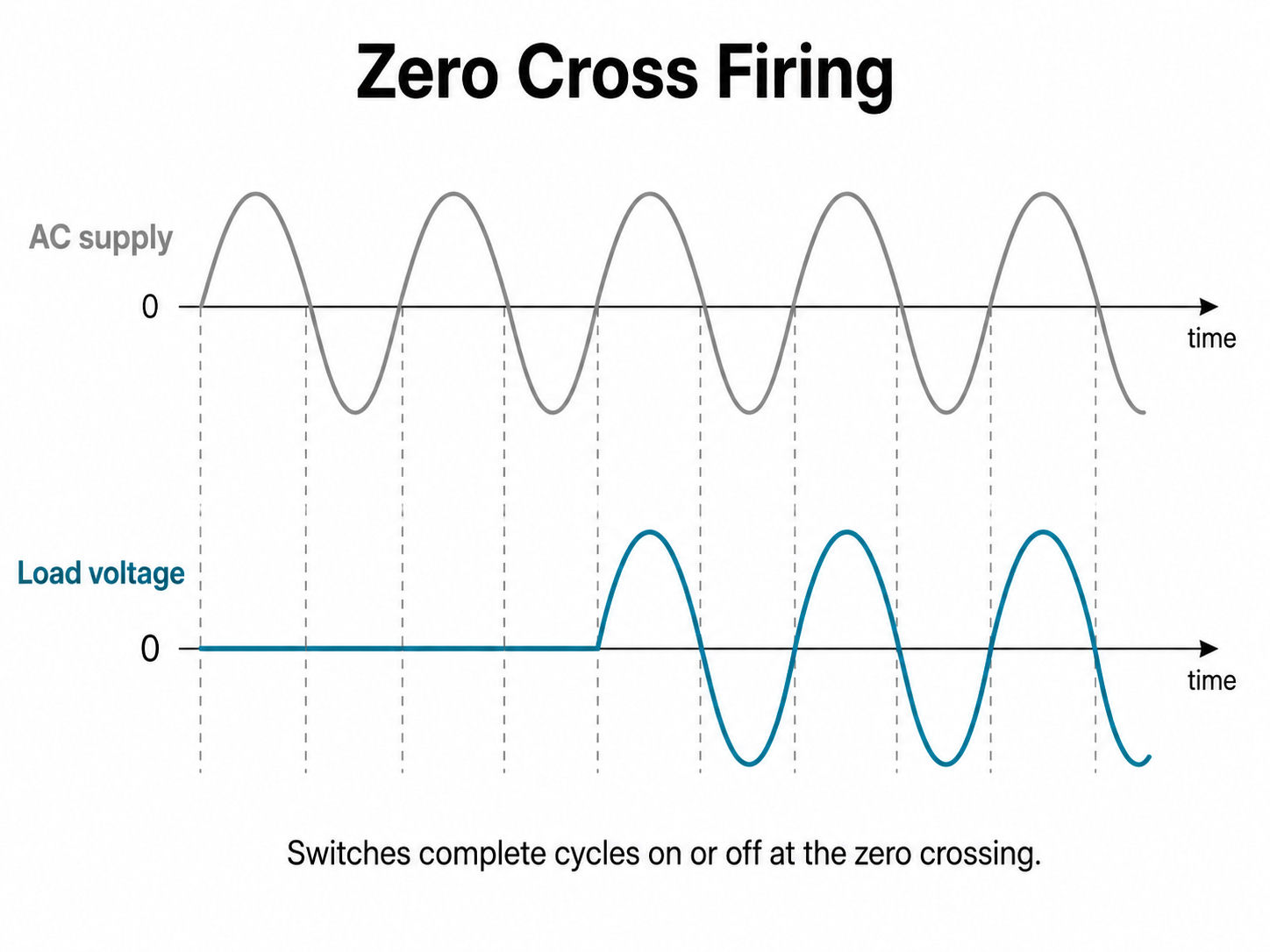
Zero crossing control switches the thyristor on when the AC waveform crosses zero volts. This means the load is energised at the lowest voltage point in the cycle, reducing electrical disturbance compared with random switching.
For many straightforward resistive heating applications, this is a reliable and cost-effective method of control. It is particularly well suited to applications where the load is stable and does not require very fast power modulation.
Typical examples include ovens, tanks, dryers, hot plates, packaging machinery, and general industrial resistance heating.
The customer benefit is simple: cleaner switching, reduced maintenance compared with mechanical contactors, and improved reliability. Unlike contactors, thyristor controllers have no moving mechanical contacts to wear out, making them far better suited to frequent switching in industrial heating processes.
Products such as the REVO S are commonly used where a compact, robust solid-state solution is required to replace contactors and improve switching reliability.
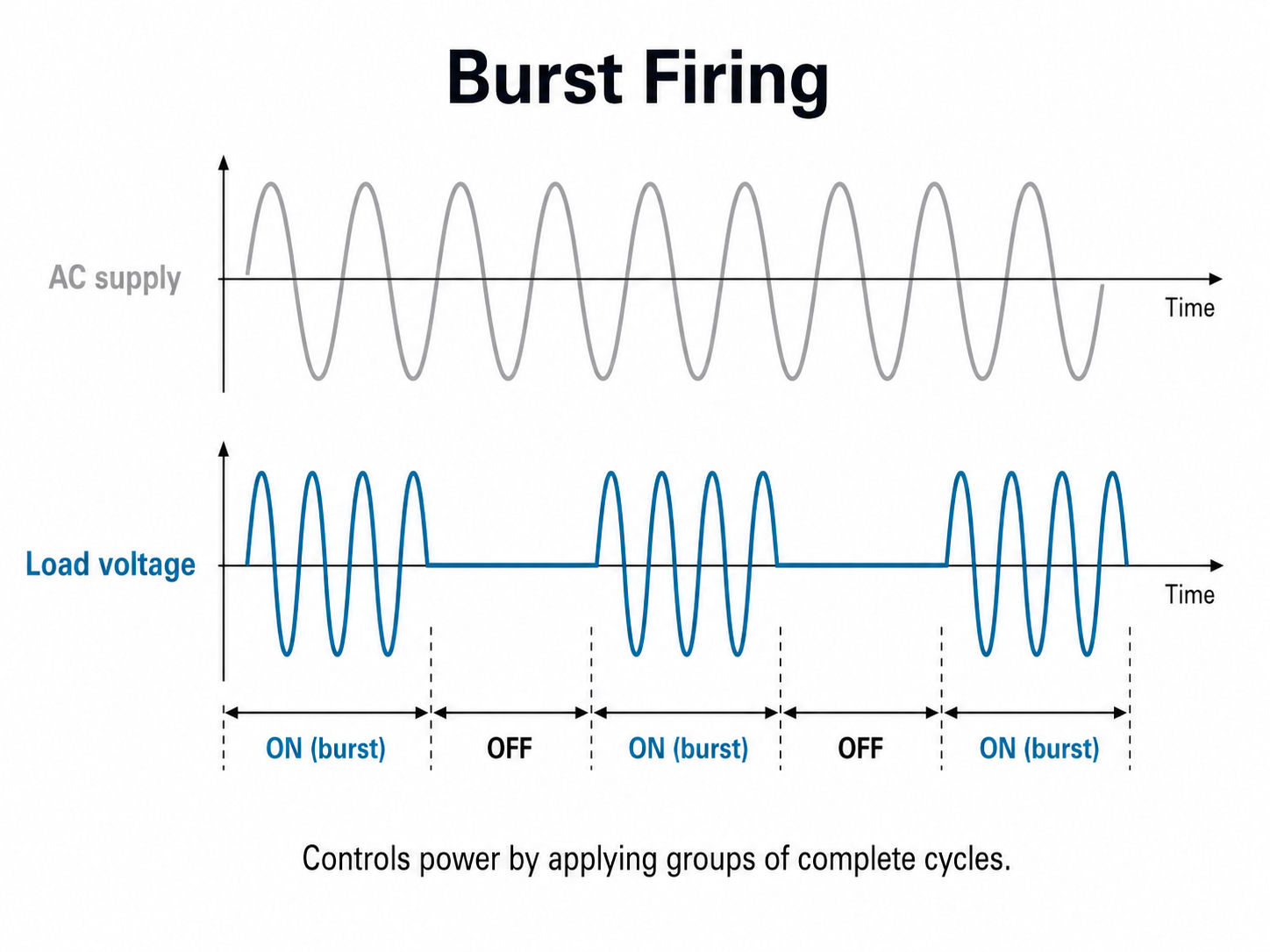
Burst firing controls power by switching complete cycles of the AC waveform on and off. Instead of switching every few minutes like a contactor, the thyristor can deliver controlled bursts of full sine waves in response to the demand signal from a temperature controller or PLC.
For example, at 50% demand, the controller may deliver power for a number of cycles and then remain off for a number of cycles. The shorter and more controlled this burst pattern is, the smoother the power delivery becomes.
This is very effective for many resistive heating loads because the heater receives full sine-wave power without the electrical noise associated with phase angle control. It also gives much finer control than mechanical contactor switching.
For the customer, the benefits include improved temperature stability, less wear on switching components, better process repeatability, and reduced risk of overshoot or undershoot.
Burst firing is often the preferred method for standard resistive heaters, medium and long-wave infrared heaters, industrial ovens, furnaces, dryers, kilns, tanks, and heated tooling.
Some heating processes need faster power correction than standard burst firing can provide. In these cases, single cycle or half cycle firing can be used.
Single cycle firing switches individual complete cycles of the AC waveform. Half cycle firing goes further, controlling power in even smaller portions of the waveform.
These methods can be valuable where fast response is required, but where it is still desirable to avoid the electrical distortion associated with phase angle control.
For the customer, this can mean tighter process control, faster correction to changing demand, and better temperature uniformity in applications where the heater or product responds quickly.
This is especially relevant in applications such as infrared heating, thin material processing, web heating, plastics, packaging, coating lines, and other processes where product quality can be affected by small changes in heat input.
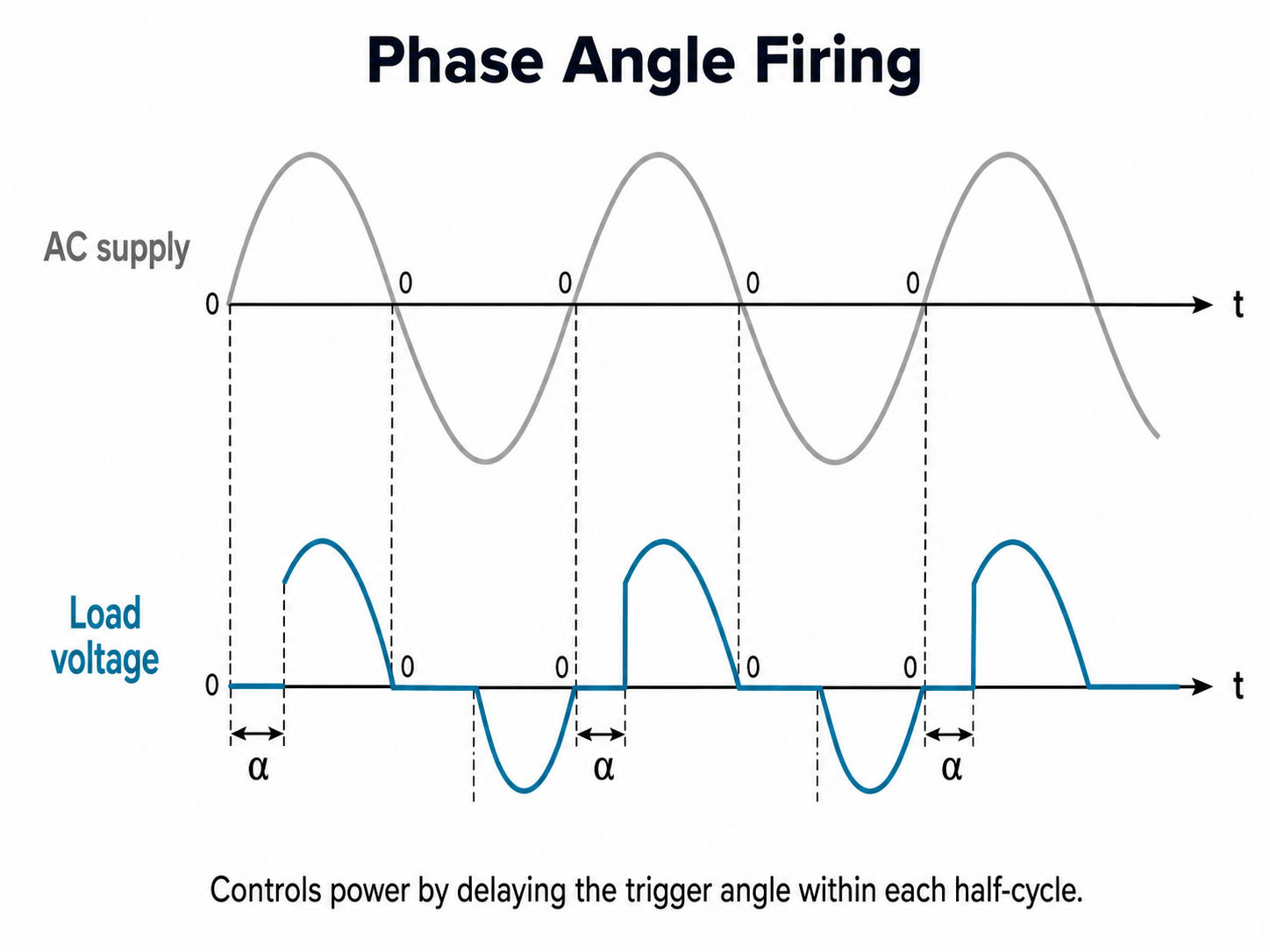
Phase angle control works differently. Instead of switching complete cycles on and off, the thyristor switches part-way through each half cycle of the AC waveform. By changing the firing angle, the controller varies the amount of voltage and current delivered to the load.
This gives very fine and fast control of power.
Phase angle is particularly useful for more complex loads, including transformer primaries, short-wave infrared lamps, inductive loads, and heating elements with a resistance that changes significantly with temperature.
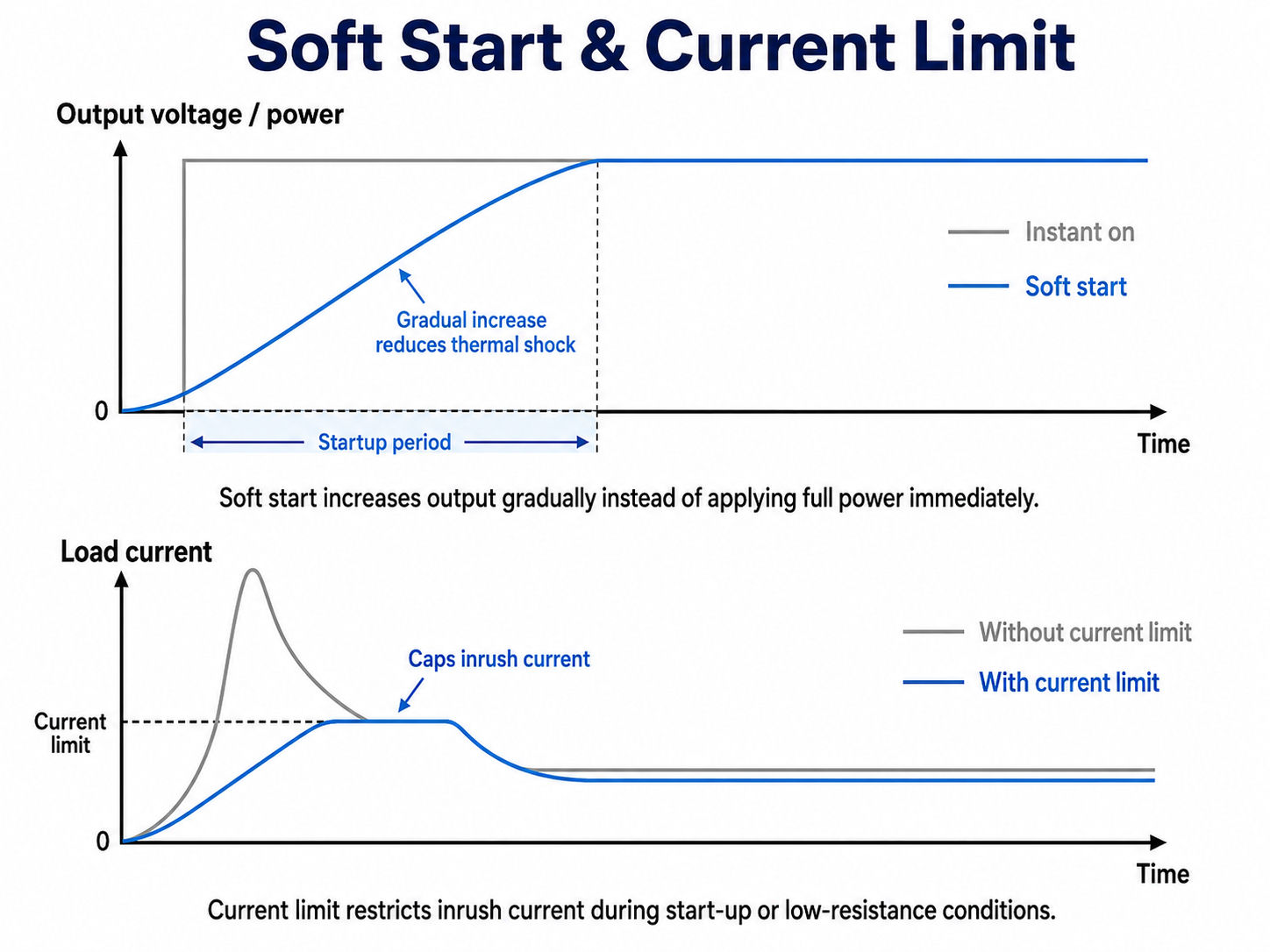
For example, some heaters have a very low resistance when cold. If full voltage is applied immediately, the inrush current can be extremely high. Phase angle control, often combined with soft start and current limit, allows the power to be ramped up in a controlled way.
For the customer, this can protect heaters, transformers, fuses, cables, and upstream protective devices. It also helps reduce nuisance tripping and allows the heating system to start more smoothly and predictably.
This is where a universal thyristor controller such as REVO C becomes particularly valuable. It is designed for more demanding SCR applications and supports advanced firing modes, including phase angle, burst firing, delayed triggering and soft start, making it suitable for a wide range of industrial heating loads.
Transformer-coupled heating loads require particular care. If power is applied at the wrong point in the waveform, the transformer can draw high magnetising current, causing nuisance trips, fuse stress, or instability.
Delayed triggering is designed to help manage these conditions. It delays the firing of the thyristors to suit the behaviour of the transformer and connected load.
For the customer, the result is a more controlled start, reduced electrical stress, and improved reliability when controlling transformer primaries.
This is particularly important in furnace applications, high-temperature heating systems, and installations using special heating elements connected via transformers.
Many heating systems are most vulnerable at start-up.
Cold heaters may draw more current than expected. Transformers may experience magnetising inrush. Short-wave infrared lamps may require controlled energisation. Special elements such as silicon carbide or molybdenum disilicide may have electrical characteristics that change significantly during operation.
Soft start allows the controller to increase power gradually rather than applying full output immediately. Current limit prevents the load current from exceeding a defined value.
Together, these features help protect the heating system from electrical and thermal stress.
The customer benefit is reduced component stress, fewer blown fuses, fewer nuisance trips, improved heater life, and a more predictable start-up sequence.
In production environments, this matters because a heating system that starts reliably is less likely to delay production, damage product, or require maintenance intervention.
The firing mode is not just an electrical setting. It affects the process.
A poor firing mode selection can create visible and hidden problems, including unstable temperature control, poor product consistency, premature heater failure, transformer noise, high peak currents, electrical interference, low power factor, and unnecessary downtime.
A correctly selected firing mode can improve the entire heating system.
It can help the customer achieve smoother heat input, better temperature stability, longer heater life, reduced maintenance, improved reliability, cleaner electrical operation, lower peak demand, and better integration with PLC or temperature control systems.
This is why firing mode selection should be considered during the design stage of any electrical heating system, not treated as an afterthought during commissioning.
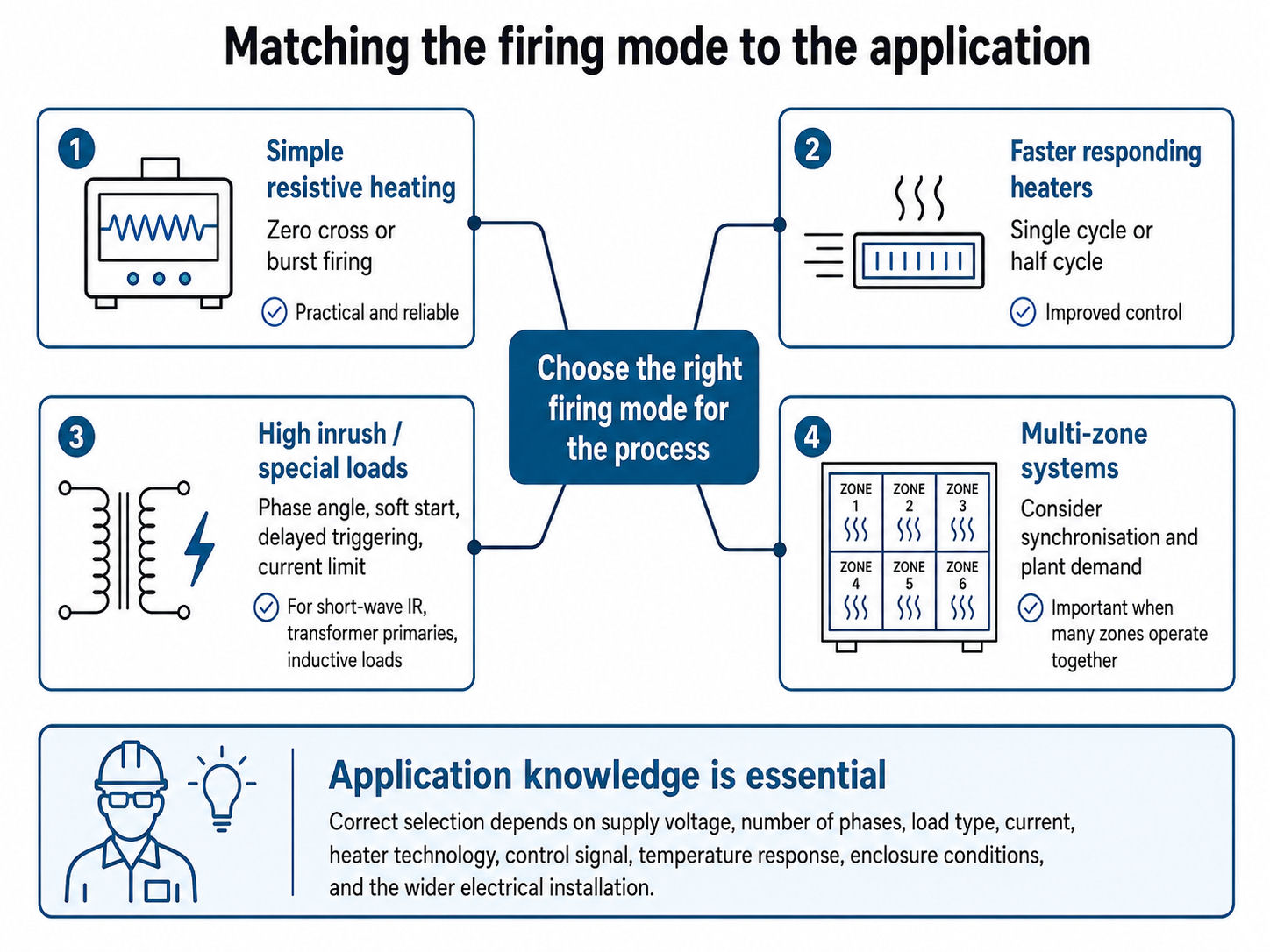
There is no single firing mode that is best for every process.
For simple resistive heating, zero crossing or burst firing is often the most practical and reliable solution.
For faster responding heaters, single cycle or half cycle firing may offer improved control.
For short-wave infrared, transformer primaries, inductive loads, or heaters with high inrush current, phase angle, soft start, delayed triggering, and current limit may be required.
For multi-zone systems, firing mode selection may also need to consider synchronisation and overall plant demand, especially where many heating zones are operating together.
This is where application knowledge becomes essential. The correct recommendation depends on the supply voltage, number of phases, load type, current, heater technology, control signal, temperature response, enclosure conditions, and wider electrical installation.
CD Automation thyristor power controllers are designed to match the firing method to the heating process.
For straightforward resistive heating and contactor replacement, REVO S provides a compact and reliable solid-state solution with zero crossing and burst firing options.
For more demanding applications, REVO C provides a universal platform with advanced firing modes including burst firing, phase angle, delayed triggering and soft start, along with current limit, measurement functions, communications and configuration flexibility.
For multi-zone heating systems, CD Automation solutions can also support synchronisation, diagnostics, communication and power management, helping OEMs and end-users improve reliability and reduce avoidable energy and maintenance costs.
The result is not just better control of electrical power. It is better control of the heating process.
In industrial heating, the way power is delivered matters.
Two systems may use the same heater, the same temperature controller and the same sensor, but perform very differently depending on the thyristor firing mode selected.
Choosing the correct firing mode helps protect electrical equipment, improve temperature stability, extend heater life, reduce downtime, and deliver a more consistent process.
That is why effective heating control is not simply about switching power. It is about understanding the load, the process, and the best way to apply energy.
For OEMs, system integrators and end-users, working with a specialist in thyristor power control ensures the controller is not just correctly sized, but correctly applied.

