
The process may continue running. The temperature controller may still show that the zone is calling for heat. The operator may not see an alarm straight away. But inside the machine, oven, furnace, dryer or heated tool, one part of the heating system may already be underperforming.
By the time the problem becomes visible, it may have caused poor product quality, uneven heating, extended warm-up times, excess energy use, or a full production stoppage.
This is why heater break alarms and load diagnostics are so valuable.
They turn the thyristor power controller from a simple power-switching device into an intelligent part of the heating system. Instead of only applying power, the controller helps monitor whether the load is behaving as expected.
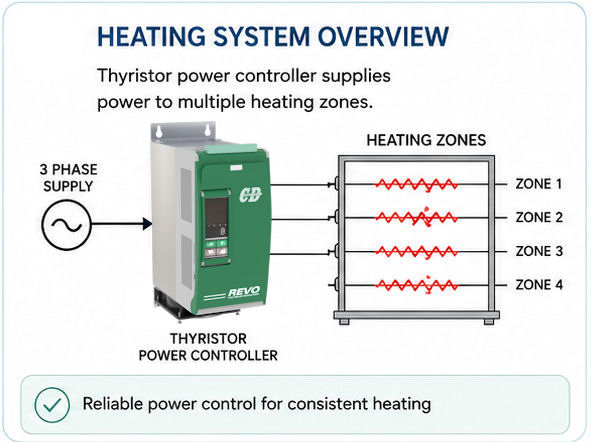
In a simple single-zone heating system, a complete heater failure may be easy to identify. The temperature drops, the controller output goes to maximum, and the process eventually alarms.
But most industrial heating systems are not that simple.
Many heating zones contain multiple heater elements connected together. A zone may have several cartridge heaters, ceramic heaters, infrared lamps, heating bands, elements, or heater banks wired in parallel or series-parallel combinations.
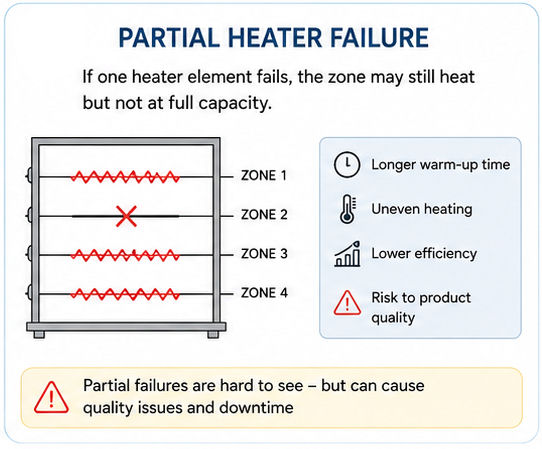
If one element fails, the zone may still heat, just not properly.
The temperature sensor may be located away from the failed part of the load. The controller may compensate by increasing output. The displayed temperature may remain close to setpoint while the actual heat distribution across the product becomes uneven.
This is particularly important in applications such as plastics machinery, packaging lines, ovens, coating systems, furnaces, dryers, thermoforming equipment, food processing lines and multi-zone heating systems.
A partial heater failure can be far more damaging than a complete failure because it can remain hidden for longer.
A heater break alarm monitors the electrical behaviour of the heating load and identifies when the current, resistance, or load condition no longer matches the expected value.
In practical terms, it helps detect whether part or all of the heating load has failed.
Depending on the controller, load type and system configuration, a heater break alarm can help identify a wide range of electrical heating faults. These may include partial load failure, total load failure, an open circuit heater, a blown fuse, abnormal current, load imbalance, or a thyristor short circuit.
In practice, this means the power controller is not only switching the heating load on and off. It is also monitoring whether the load is behaving as expected.
Where heater break detection is correctly configured, the system can be calibrated against the normal operating condition of the heating zone. If the measured current, resistance or load behaviour moves outside the expected range, an alarm can be generated to alert operators or maintenance teams.
This can help identify both complete heater failure and more subtle problems, such as one failed element within a multi-element heating zone.
The main benefit of heater break detection is not simply that it produces an alarm.
The real benefit is that it gives operators, engineers and maintenance teams earlier visibility of a developing process problem.
A failed heater can affect product quality long before it creates a complete machine stoppage. In many processes, uneven heat input can cause scrap, rework, longer cycle times, poor curing, incorrect sealing, poor surface finish, inconsistent moisture removal, dimensional variation, or unstable process conditions.
By detecting the fault earlier, the maintenance or production team can respond before the issue becomes more expensive.
This can help reduce unplanned downtime, protect product quality, support planned maintenance, reduce troubleshooting time, and improve confidence in the heating process.
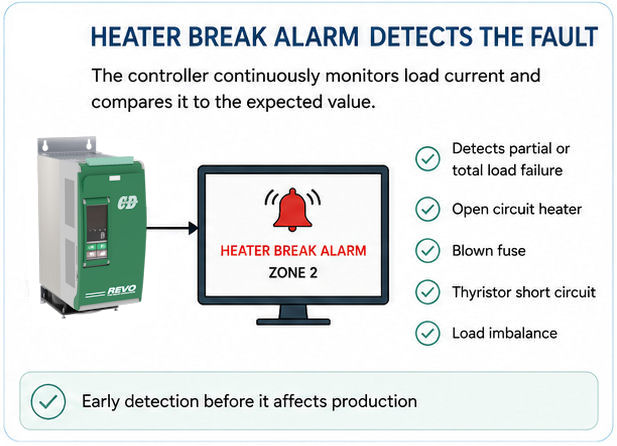
Partial load failure is one of the most important diagnostic conditions in electrical heating.
Imagine a heating zone with five heater elements connected in parallel. If one element fails open circuit, the zone may still produce heat from the remaining four elements. The temperature controller may increase its output to compensate, and the process may continue running.
However, the load is now only operating at 80% of its intended capacity. The heat distribution may be uneven, warm-up time may increase, and the remaining elements may be driven harder to maintain the process temperature.
Without load diagnostics, this type of fault can be difficult to find.
A heater break alarm can identify that the measured load no longer matches the expected calibrated value. This allows the fault to be highlighted before the process drifts too far or poor-quality product is produced.
For production teams, this is a major advantage. It changes heater failure from something discovered after a quality issue into something that can be acted on as a controlled maintenance event.
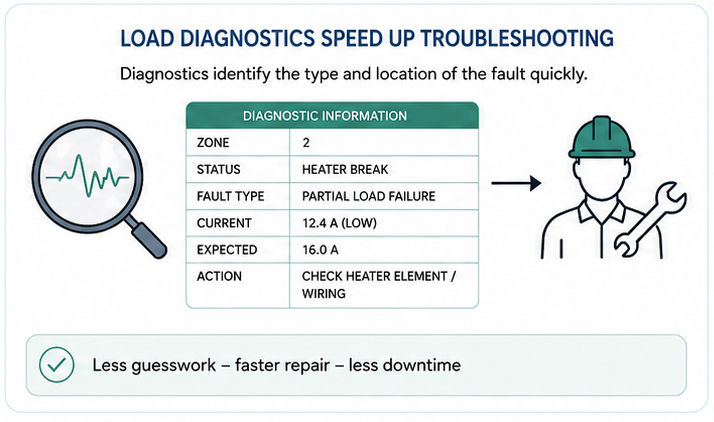
When a heating process is not performing correctly, the fault could be in many places.
It could be the temperature sensor, the temperature controller, the PLC output, the thyristor controller, a fuse, a cable, a terminal, a heater element, or the power supply.
Without diagnostics, maintenance engineers often have to spend time checking each part of the system manually.
Load diagnostics narrow the search.
If the thyristor power controller can indicate heater break, open fuse, SCR short circuit, abnormal current or load condition, the engineer has a much clearer starting point. This reduces time spent fault-finding and helps the plant return to production faster.
This is especially valuable on large multi-zone systems where there may be dozens of heating zones. In these applications, knowing exactly which zone has the problem is far more useful than simply knowing that the machine temperature is unstable.
Multi-zone systems are where heater diagnostics become even more powerful.
On a machine with 12, 24 or more heating zones, a single failed heater can be difficult to identify manually. The issue may appear as a process variation rather than an obvious electrical fault.
CD Automation’s REVO PN is designed for industrial multi-zone applications and can manage independent process information for each loop. Its published features include diagnostics for SCR temperature, SCR short circuit and open fuse, along with instant current, RMS voltage, current and power calculation, load resistance calculation and Heater Break Alarm.
For engineers and machine technicians, this means each zone can be monitored as part of the wider heating system. Instead of treating each power controller as an isolated component, diagnostics can be brought into the control architecture and made visible to the PLC, HMI or maintenance system.
This is a major benefit for OEMs and end-users who want cleaner panels, faster commissioning, better serviceability and more useful process data.
Traditional heater break alarms often used a simple relay output or front-panel indication. That is still useful, especially on smaller systems.
However, modern heating systems increasingly require diagnostic information to be communicated digitally. Engineers and operators want to see which zone has failed, what type of fault has occurred, and whether the problem is electrical, thermal or process-related.
This is where fieldbus communications become important.
CD Automation’s multi-channel and connected product ranges support integration with industrial communication systems, allowing alarm and diagnostic data to be shared with PLCs and supervisory systems.
REVO PC documentation highlights alarm notification per zone for heater break and thyristor short circuit, energy monitoring using true RMS measurement, and fieldbus connectivity.
The customer benefit is practical. Faults can be displayed on the HMI, logged for maintenance, used in alarm history, and included in wider machine diagnostics.
This helps move the heating system from reactive maintenance toward planned and informed maintenance.
In many industries, the cost of a heater fault is not just the cost of replacing the heater.
The larger cost may be lost production, wasted material, rejected batches, delayed orders, machine downtime, or complaints from downstream users or end customers.
In food processing, uneven heating can affect consistency, drying, sealing or cooking. In plastics, it can affect material flow, moulding stability or extrusion quality. In coatings and converting, it can affect curing, adhesion, drying and surface finish. In furnaces and kilns, it can affect temperature uniformity and batch quality.
Heater break detection helps protect against these issues by identifying electrical load problems before they become process-quality problems.
This is one of the strongest customer messages: diagnostics are not just for maintenance engineers. They are also a quality-control tool.
A heating system with useful diagnostics allows maintenance teams to plan better.
Instead of waiting for a zone to stop working completely, engineers and machine technicians can identify a partial failure and decide when to intervene. On some processes, the line may be able to finish a production run before maintenance replaces the failed heater. On others, the alarm may trigger immediate action to prevent scrap.
Either way, the customer has better information.
This reduces the risk of unexpected stoppages and allows heater replacement, fuse checks, wiring inspections and panel maintenance to be carried out in a more controlled way.
For multi-site manufacturers and OEMs, this also supports standardisation. When diagnostic information is available in a consistent format, maintenance teams can respond more efficiently across different machines or production lines.
Heater break diagnostics are not only about the heater.
A thyristor power controller may also detect faults such as thyristor short circuit. This is important because a shorted thyristor can result in uncontrolled power being applied to the load.
In a safety-critical or temperature-sensitive process, uncontrolled heating can cause serious process problems. Early detection allows the control system to alarm, isolate, or take appropriate action depending on the machine design.
CD Automation’s REVO S product information identifies Heater Break alarm functionality for diagnosing partial or total load failure and thyristor short circuit, while REVO PC literature also refers to alarm notification per zone for heater break and thyristor short circuit.
For machine builders, engineers and end-users, this adds another layer of protection and visibility.
The commercial value of heater break alarms and load diagnostics is easy to underestimate.
At component level, it may look like an optional feature. At process level, it can save significant time and cost.
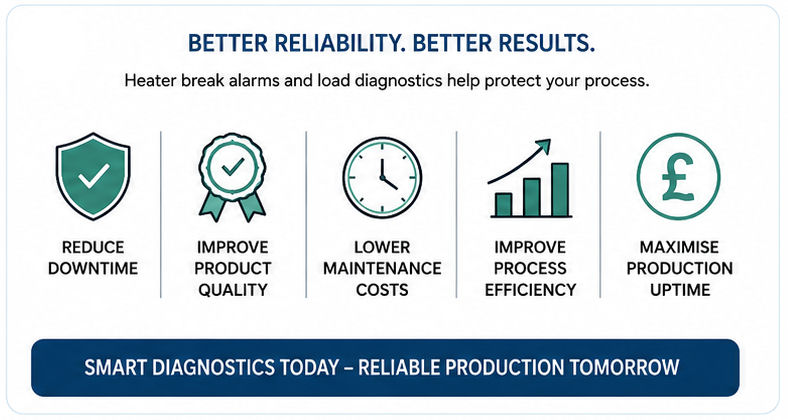
The benefits include earlier detection of failed heaters, reduced scrap and rework, faster fault-finding, fewer unplanned stoppages, improved maintenance planning, better process visibility, reduced machine downtime, increased operator confidence, and easier PLC/HMI integration.
For OEMs, these features also improve the perceived quality of the machine. A machine that can tell the customer what is wrong is more valuable than one that simply stops heating.
For end-users, diagnostics reduce dependency on manual investigation and help maintenance teams make faster, better decisions.
CD Automation offers heater break and diagnostic functionality across a wide range of thyristor power controllers.
For compact applications and contactor replacement, REVO S can provide heater break alarm functionality to detect partial or total load failure and thyristor short circuit.
For more advanced applications, REVO C provides a universal power controller platform with integrated measurement, configuration flexibility, communications, and diagnostic capability.
For multi-zone systems, REVO PN and REVO PC allow diagnostic information to be managed across multiple heating zones, helping engineers, OEMs and maintenance teams reduce wiring, improve visibility, communicate with PLC systems and identify zone-level faults more effectively.
The correct solution depends on the application. A single-zone oven, a three-phase heater bank, a transformer-coupled furnace and a 24-zone plastics machine all have different diagnostic requirements.
This is why application knowledge matters.
Heater break alarms and load diagnostics are not just optional extras. They are essential tools for improving the reliability, visibility and maintainability of electrical heating systems.
They help engineers and maintenance teams detect hidden heater failures, reduce troubleshooting time, protect product quality, and avoid unnecessary downtime.
In modern industrial heating, the best power controller is not just the one that delivers power accurately. It is the one that also tells you when the heating system is no longer behaving as it should.
By combining thyristor power control with intelligent diagnostics, CD Automation helps machine builders, engineers and end-users move from reactive fault-finding to informed, reliable heating-process control.
