Rubber processing equipment must deliver one critical outcome: consistent curing.
Unlike many thermal processes, curing does not simply depend on reaching a temperature. It requires a precise balance of temperature, time and pressure, all applied uniformly across the product.
For OEMs, this creates a complex design challenge. Heating systems must deliver stable and evenly distributed heat while responding predictably across repeated cycles and varying load conditions.
Achieving this level of control requires careful integration of heating, power delivery and machine design.
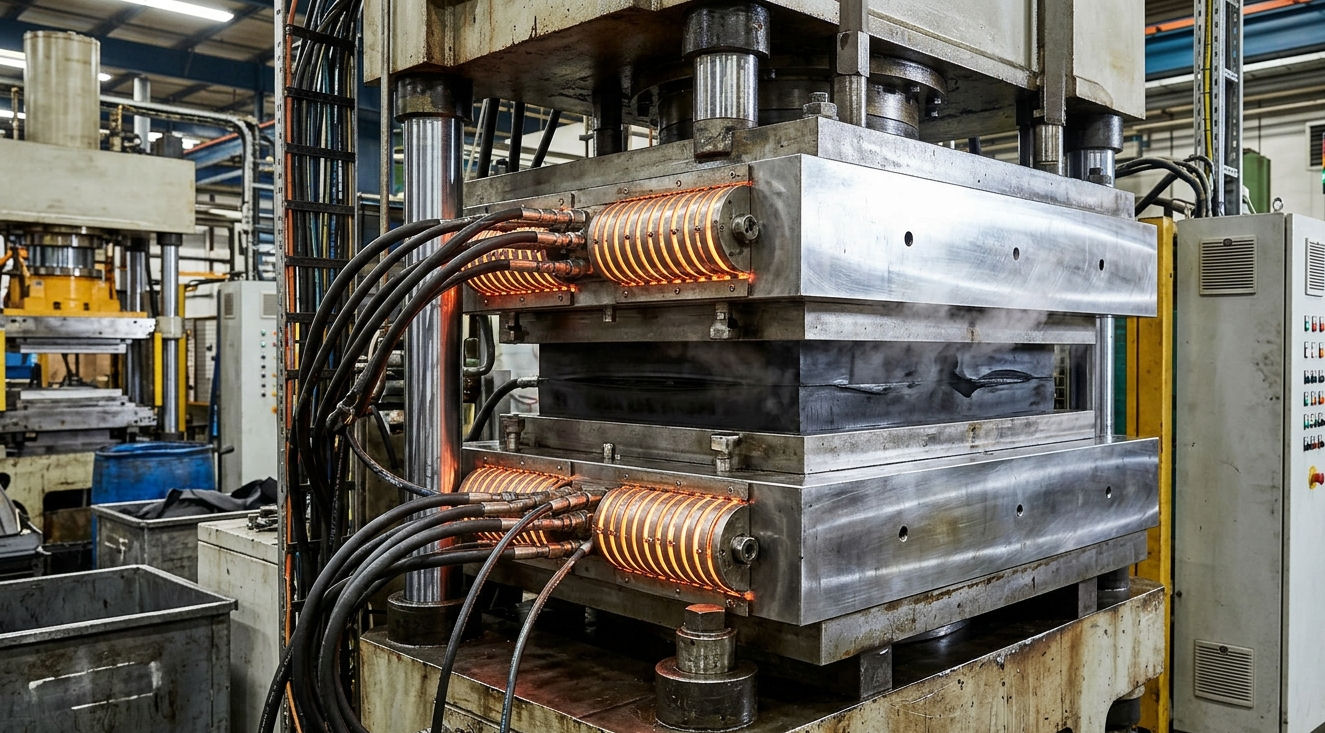
Heating systems in rubber processing equipment often use embedded resistive elements within platens or heating zones.
These systems must respond evenly and predictably to control inputs.
Uneven power distribution can create localised hot or cold spots, which directly affect curing behaviour.
Designing for uniform thermal response requires:
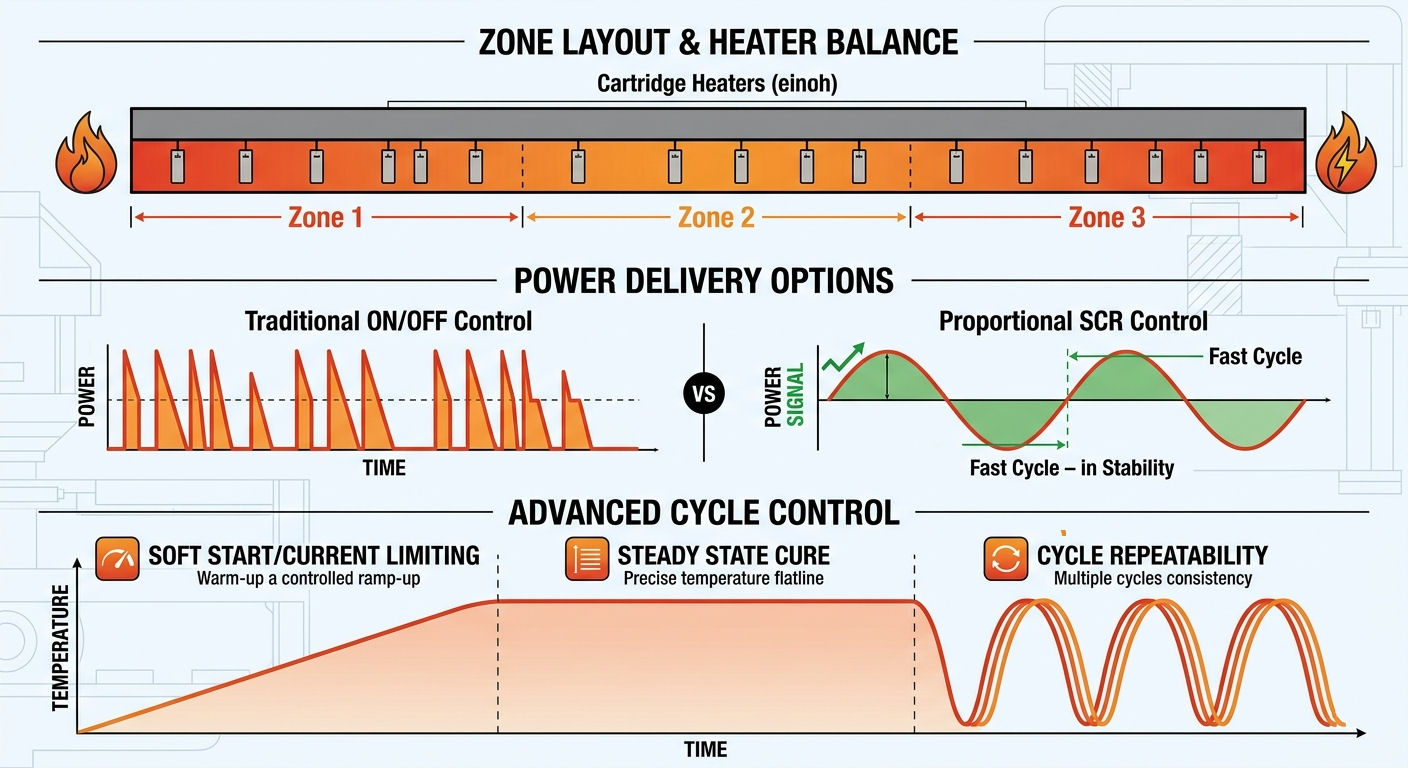
Power control plays a key role in ensuring that each zone receives stable and appropriate energy input.
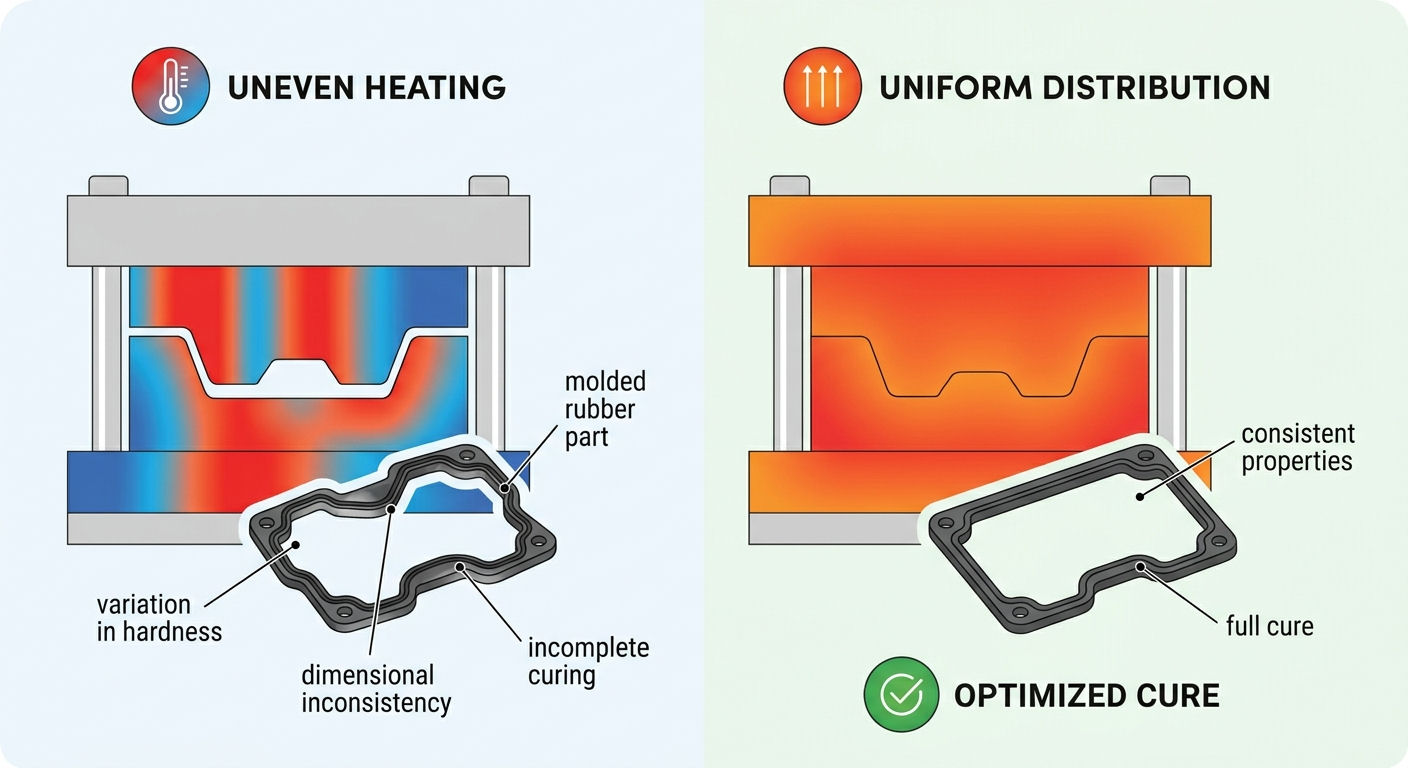
Curing performance depends heavily on how heat is distributed within the equipment.
In presses and moulding systems, heat must transfer evenly through platens, moulds and the material itself. Any variation in temperature can lead to uneven curing across the part.
Mould temperature directly influences how the material cures.
If heat distribution is uneven, the process can produce:
Maintaining uniform temperature across the mould surface is essential for consistent product quality.
In continuous processes, such as extrusion and vulcanisation lines, heat must remain stable along the length of the system.
Any fluctuation in thermal conditions can affect curing rate, leading to variation in material properties along the product.
Stable heat delivery ensures consistent curing throughout the process.
Rubber processing often operates in repeated cycles, particularly in moulding and press applications.
Each cycle must follow the same thermal profile to ensure consistent curing results.
If power delivery varies between cycles, even slightly, it can lead to variation in:
More controlled and proportional power delivery helps ensure that each cycle behaves consistently, supporting repeatable production.
Rubber processing equipment must handle varying operating conditions, including cold start-up and changes in load.
At start-up, heating systems must bring tooling up to temperature in a controlled manner. Applying full power immediately can create uneven heating and thermal stress.
Power controllers that support soft start and current limiting allow gradual energisation, helping achieve more uniform temperature distribution during warm-up.
During operation, variations in material load or cycle conditions can also affect heat demand. Responsive power control helps maintain stable conditions despite these changes.
Rubber processing machines often operate in high-throughput environments where downtime directly impacts productivity.
Heating system failures can interrupt production and lead to scrap, particularly if curing cycles are affected.
Mechanical contactors used for switching heaters degrade over time due to frequent cycling. This increases the risk of failure in demanding applications.
Solid-state power controllers eliminate these mechanical wear points and provide consistent performance over time.
Modern systems also include early fault detection, allowing heater issues to be identified before they disrupt production.
This supports proactive maintenance and helps maintain machine uptime.
Consistent curing requires visibility into how the system is performing.
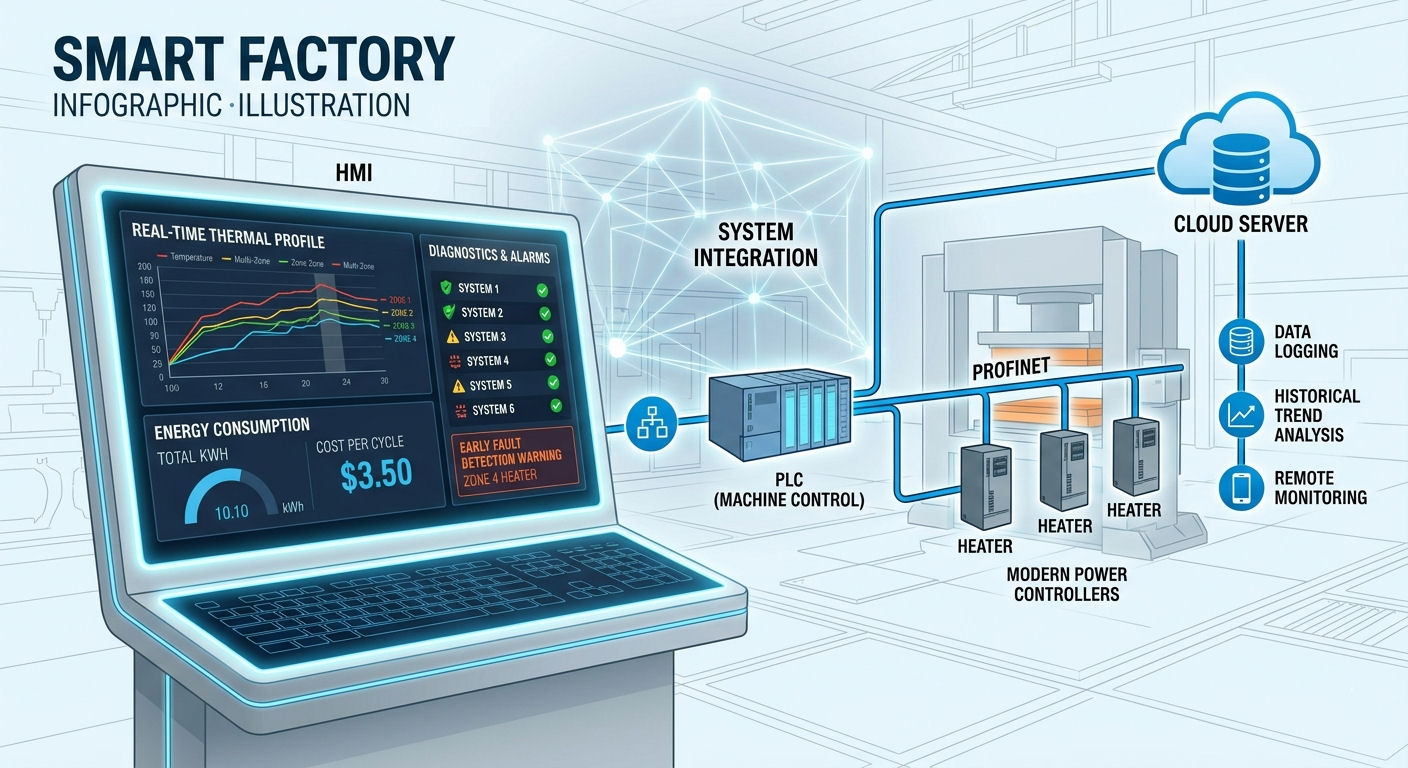
Modern power controllers provide real-time monitoring, allowing engineers to track heating behaviour and identify variation across zones.
Historical data logging allows trends to be analysed over time.
This helps identify sources of variation and supports optimisation of curing conditions.
Heating represents a significant portion of energy consumption in rubber processing.
Integrated energy monitoring and totalisation allow OEMs and end users to track usage and improve efficiency.
Rubber processing equipment must operate as part of a coordinated control system.
Power controllers that support Profinet and Profibus integrate with PLC systems, allowing heating performance, alarms and diagnostics to be monitored centrally.
This ensures that heating systems operate in alignment with machine cycles and process requirements.
Integration also simplifies system design and improves overall control.
The illustration shows an HMI screen visualizing multi-zone thermal graphs, energy monitoring, and "Early Fault Detection Warnings" linked to a cloud server.
By combining uniform heat distribution, stable power delivery and reliable system design, OEMs can achieve consistent curing performance.
This enables:
In curing processes, where final product performance depends entirely on thermal conditions, this level of control is essential.
Selecting the right power control approach requires understanding both the heating system and the curing process.
Applications involving presses, moulding systems and continuous lines demand stable and responsive heating control.
CD Automation’s thyristor power controllers, including REVO S, REVO C and REVO PC, provide advanced firing modes, current limiting and diagnostic capabilities.
These systems deliver stable power control, early fault detection, energy monitoring, real-time visibility and seamless integration with machine control systems.
This allows OEMs to design equipment that achieves consistent curing performance, improved reliability and better overall process control.

If you are designing rubber processing equipment and need to improve curing consistency, reliability or system integration, CD Automation can support you in selecting the most appropriate power control solution.
Contact CD Automation to discuss your heating application or arrange a technical review of your system.
Further application information can be found on our Rubber Processing, Compounding & Curing page.
Or contact our engineering team to assess your current heating control strategy.
Click the link in the page footer below to ‘Book a telephone callback’, or click the ‘Contact Us' button to request a no-obligation quotation, or simply ask a question. We're here to help.

