Molten glass behaves very differently from most industrial materials.
Its viscosity changes rapidly with temperature, meaning even small thermal variations can significantly alter how the material flows, forms and solidifies. This sensitivity makes temperature control one of the most critical aspects of glass production.
From the furnace through to the forehearth, maintaining stable and uniform thermal conditions determines whether the process produces consistent, high-quality glass, or defects that lead to waste and rework.
Achieving this level of control depends not only on temperature measurement, but on how heat is delivered into the process.

Glass production operates within a narrow thermal window.
A slight increase in temperature can reduce viscosity, causing the glass to flow too easily. A slight decrease can increase resistance to flow, affecting forming and shaping processes.
These variations can lead to:
Because glass remains in a semi-fluid state over a wide temperature range, these effects can propagate through the process, making them difficult to correct downstream.
Maintaining stable heat input is therefore essential to keeping the process under control.

Glass manufacturing involves multiple thermal zones, each with a specific role in shaping material behaviour.
The furnace must deliver consistent heat to maintain a stable melt pool.
Instability at this stage can lead to variation in melt quality, affecting everything downstream.
As the glass moves through the furnace, temperature must be controlled to remove bubbles and stabilise composition.
Fluctuations in heat input can disturb this balance, leading to inclusions or defects in the final product.
The forehearth controls the final temperature of the glass before forming.
This stage is particularly sensitive. Small temperature differences across the forehearth can result in uneven viscosity, affecting gob formation and final product quality.
Stable and uniform heat delivery is critical to maintaining consistent forming conditions.
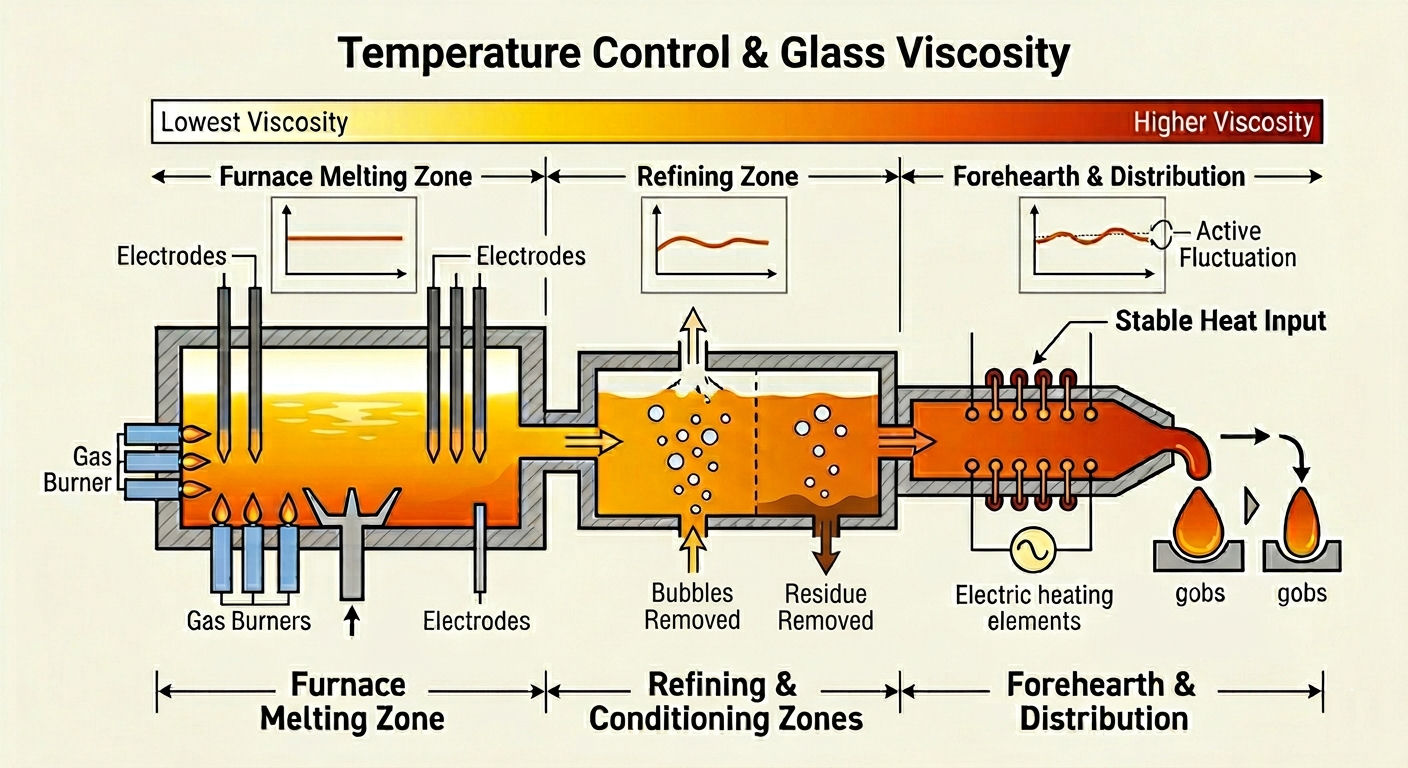
This diagram illustrates the different thermal zones and viscosity changes across the glass production process. A colour gradient bar along the top transitions from bright white-yellow (hottest) in the furnace to deep orange-red (cooler) in the forehearth, indicating viscosity levels.
Temperature controllers define the target conditions, but the way electrical power is applied determines how the system responds.
If power is delivered in large or uneven steps, it can introduce subtle fluctuations in heat input. In glass processes, these fluctuations can translate directly into viscosity changes.
Because the material responds continuously, even minor instability in power delivery can affect:
More refined power control allows heat to be applied smoothly, reducing disturbance and supporting stable melt conditions.
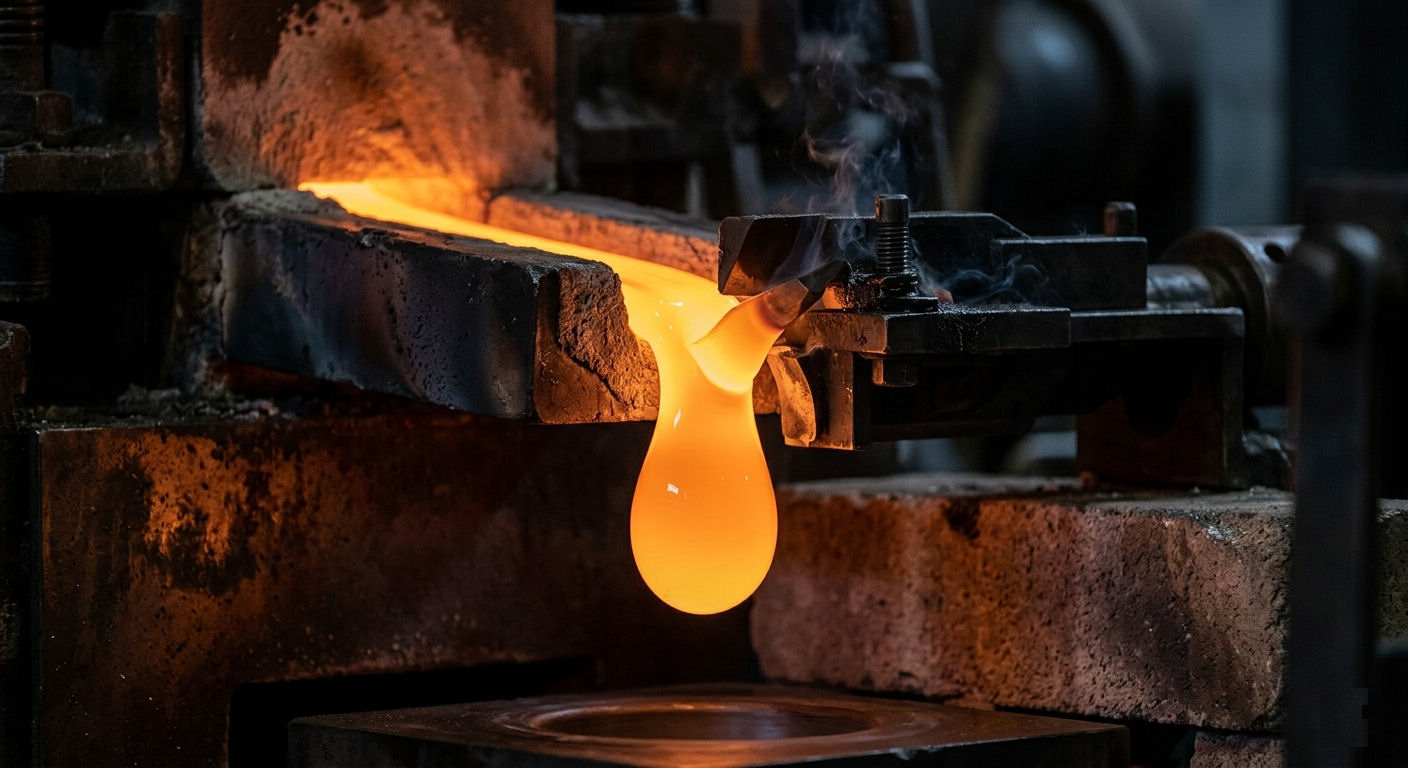
Glass furnaces often use a combination of heating methods, including resistance heating and electrode-based boosting systems.
These systems can present complex electrical characteristics, particularly where high current or transformer-based supplies are involved.
In such cases, phase angle firing provides smooth and controlled power delivery, helping to avoid electrical disturbance and maintain stable heating.
Where systems experience high inrush currents or dynamic load conditions, additional strategies such as current limiting and soft start help protect both the electrical infrastructure and the heating elements.
Selecting the correct control approach ensures that energy is introduced into the process in a controlled and predictable way.
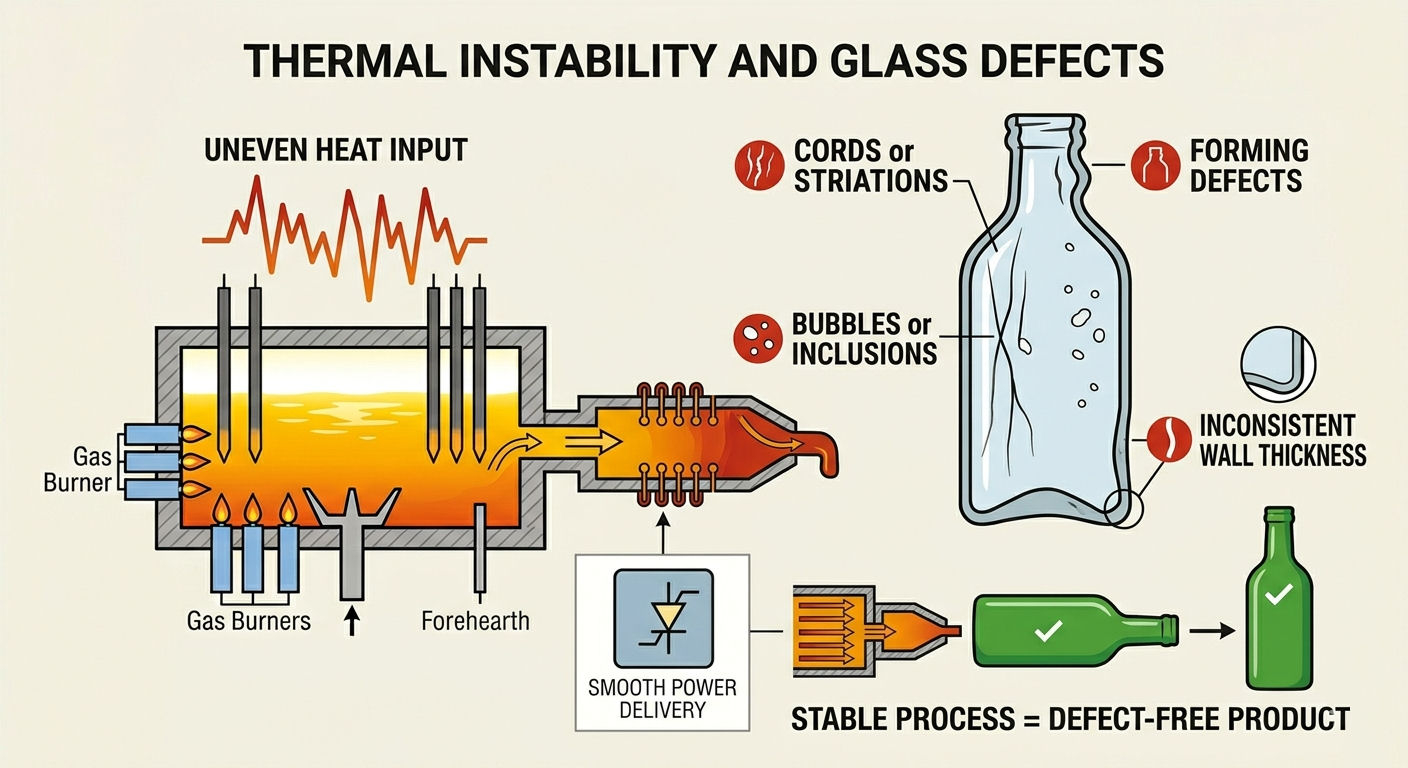
Many common glass defects can be traced back to thermal instability.
Variations in temperature can lead to:
Because these issues originate upstream, they often cannot be corrected later in the process.
Improving heating stability reduces the likelihood of these defects and supports consistent product quality.
Glass production typically operates as a continuous process.
Any disruption to heating can have serious consequences, including:
Mechanical contactors used in heating systems are subject to wear due to constant operation. Over time, this increases the risk of failure.
Solid-state power controllers remove this limitation and provide more reliable long-term performance.
Modern systems provide early fault detection, allowing heater or system issues to be identified before they impact production.
This enables proactive maintenance and helps maintain continuous operation.
Maintaining stable operation requires clear insight into how the system is performing.
Modern power controllers provide real-time monitoring, allowing engineers to observe heating behaviour and detect instability as it develops.
Historical data logging allows trends to be analysed over time, supporting optimisation of furnace performance and improved process consistency.
Glass production is energy-intensive.
Integrated energy monitoring and totalisation allow operators to track consumption, identify inefficiencies and improve overall energy management.
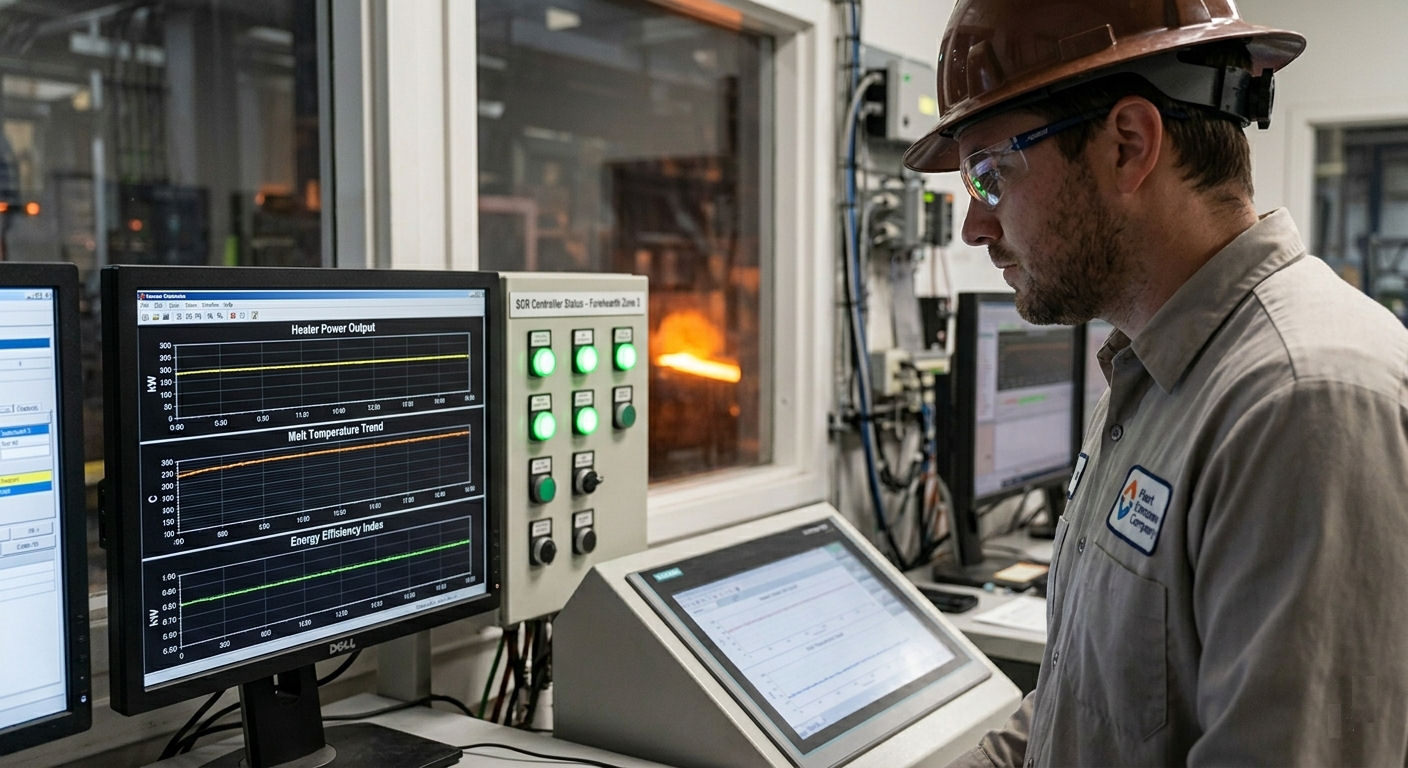
Glass production relies on coordinated control across multiple systems.
Power controllers that support Profinet and Profibus integrate with PLC and SCADA systems, allowing heating performance, alarms and diagnostics to be monitored centrally.
This improves visibility, supports faster decision-making and ensures that heating systems operate in line with overall process requirements.
Stable heat delivery underpins every stage of glass production.
By improving how energy is applied and controlled, operators can achieve:
In a process where small variations can have significant effects, this level of control is essential.
Glass manufacturing requires power control solutions that can handle high temperatures, complex electrical loads and continuous operation.
The control strategy must match both the heating system and the process requirements.
CD Automation’s thyristor power controllers, including REVO S, REVO C and REVO RT, provide advanced firing modes, current limiting and diagnostic capabilities.
These systems deliver stable power control, early fault detection, energy monitoring, real-time visibility and seamless integration with plant control systems.
This enables manufacturers to maintain consistent process conditions, reduce defects and improve overall production performance.

If your glass production process is affected by instability, defects or inconsistent forming conditions, CD Automation can support you in selecting the most appropriate power control solution.
Contact CD Automation to discuss your heating application or arrange a technical review of your system.
Further application information can be found on our Glass Manufacturing page.
Or contact our engineering team to assess your current heating control strategy.
Click the link in the page footer below to ‘Book a telephone callback’, or click the ‘Contact Us' button to request a no-obligation quotation, or simply ask a question. We're here to help.

